

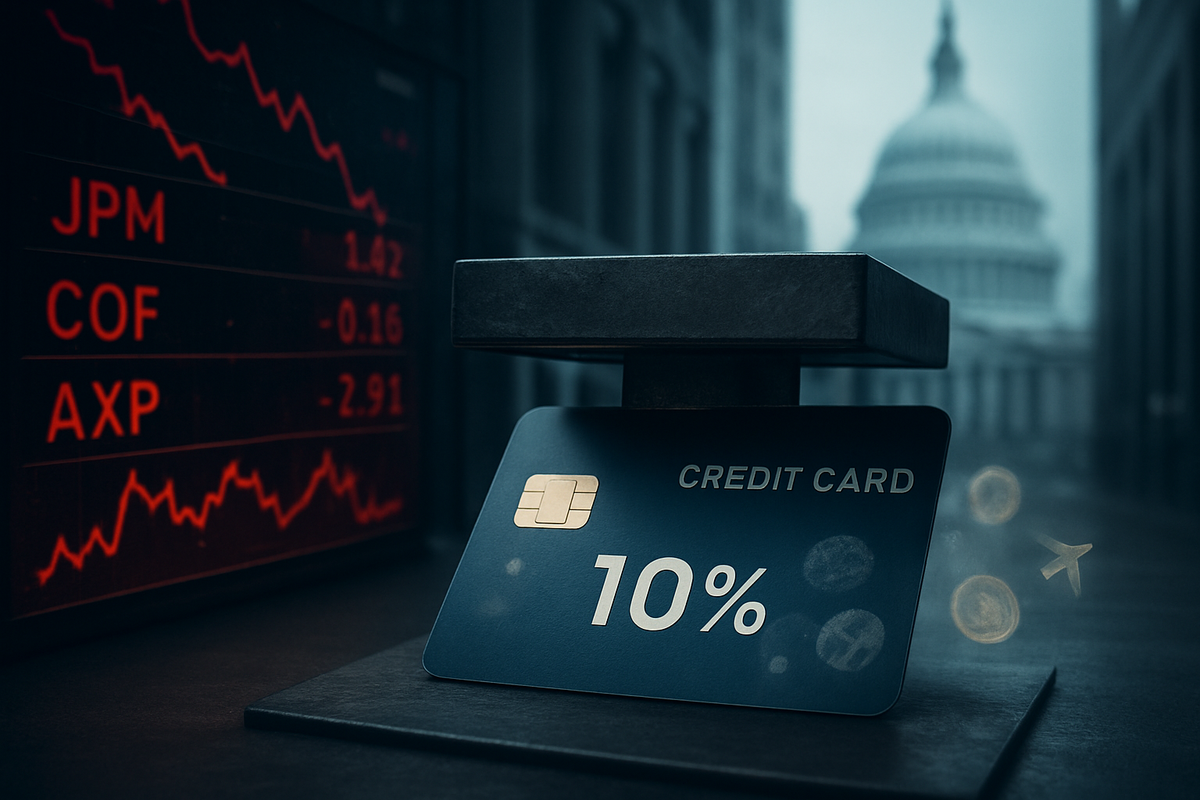
The financial sector is reeling this week as a new and aggressive regulatory threat takes center stage: a proposed 10% national cap on credit card interest rates. On January 9, 2026, President Donald Trump used a series of public statements to call for an immediate, one-year "affordability" cap to be implemented by January 20, the anniversary of his second inauguration. This populist maneuver has sparked a massive sell-off in banking stocks, as investors grapple with the possibility of a legislative or executive mandate that would fundamentally dismantle the current profitability model of the U.S. consumer credit market.
The immediate implications are stark. If enacted, a 10% cap would more than halve the average interest rate currently charged on revolving credit card balances, which hovered near 22% in late 2025. For pure-play credit card issuers, the proposal represents an existential threat to net interest margins. Beyond the immediate stock market volatility, the proposal has reignited a fierce debate over credit access, with industry groups warning that millions of subprime borrowers could be "de-banked" overnight as lenders retreat from high-risk profiles that are no longer profitable under a 10% ceiling.
The Path to the 10% Ceiling
The momentum for a national rate cap has been building since the collapse of the Consumer Financial Protection Bureau’s (CFPB) attempt to cap late fees at $8. That rule, finalized in 2024, was eventually vacated in April 2025 following a settlement between the Bureau and major banking trade groups. While the industry celebrated that "win for the rule of law," the victory proved short-lived. By mid-2025, a bipartisan coalition led by Senators Josh Hawley (R-MO) and Bernie Sanders (I-VT) introduced the "10 Percent Credit Card Interest Rate Cap Act," arguing that "usurious" rates were crushing the American middle class.
The timeline accelerated rapidly in the first week of 2026. Following a period of stubborn inflation in the service sector, the administration shifted its focus to "junk fees" and "predatory interest." The January 9 announcement caught the market off guard, as it signaled the President's intent to bypass traditional legislative gridlock. Key stakeholders, including the American Bankers Association (ABA) and the Bank Policy Institute (BPI), immediately issued statements condemning the move as "unprecedented government price-fixing" that would destroy the rewards programs millions of Americans rely on.
Initial market reactions on Monday, January 12, 2026, have been nothing short of a bloodbath for credit-sensitive equities. Trading was briefly halted for several mid-tier lenders as the market attempted to price in a world where the primary engine of banking growth—revolving interest—is capped at a level below the cost of capital for many subprime portfolios.
Winners and Losers: A Sector in Flux
The "losers" in this scenario are led by Capital One Financial Corp. (NYSE: COF), which recently finalized its massive acquisition of Discover Financial Services. As the largest credit card issuer in the country, Capital One is uniquely exposed to this policy shift. Its stock fell 8.8% in early trading today, as analysts noted that its heavy concentration of "near-prime" borrowers makes its business model highly sensitive to interest rate ceilings. Similarly, Synchrony Financial (NYSE: SYF) and Bread Financial Holdings (NYSE: BFH) saw double-digit declines. These institutions specialize in private-label credit cards for retailers, which often carry APRs exceeding 30%; a 10% cap would render their current risk-sharing agreements with retailers fundamentally unworkable.
On the other end of the spectrum, "money center" banks like JPMorgan Chase & Co. (NYSE: JPM) and Bank of America Corp. (NYSE: BAC) have seen more moderate declines of 3% to 4%. While their credit card divisions are vast, their diversified revenue streams—including investment banking, wealth management, and commercial lending—provide a significant buffer that pure-play issuers lack. American Express Co. (NYSE: AXP) has also fared better than its peers, dropping only 4.2%. Investors view AXP’s "spend-centric" model, which relies heavily on merchant discount fees and annual cardmember fees rather than interest income, as a potential safe haven.
The unexpected "winners" could emerge from the fintech and "Buy Now, Pay Later" (BNPL) sectors. Companies like Affirm Holdings, Inc. (NASDAQ: AFRM) may see a surge in demand as traditional banks tighten underwriting standards and stop issuing cards to anyone with a FICO score below 700. Because many BNPL products utilize "pay-in-four" structures that do not charge traditional interest, they may be able to bypass the 10% APR cap entirely, capturing the millions of consumers who will inevitably be displaced from the traditional credit card market.
Broader Significance and Historical Echoes
This event fits into a broader global trend of "financial populism" that has seen governments in Europe and South America implement similar caps to combat cost-of-living crises. In the U.S., the move represents a historical pivot back to the "usury laws" that governed the country before the 1978 Supreme Court decision in Marquette National Bank of Minneapolis v. First of Omaha Service Corp., which effectively allowed banks to export the interest rates of their home states across the country. A federal 10% cap would essentially reverse nearly 50 years of credit deregulation.
The ripple effects on competitors and partners will be profound. If interest income is slashed, the "Great Rewards Race" of the last decade will likely come to a screeching halt. The 2% cash-back and premium travel points offered by major issuers are largely subsidized by the interest paid by "revolvers"—customers who carry a balance. Without that high-margin revenue, banks will likely eliminate rewards programs, increase annual fees, and slash marketing budgets for customer acquisition.
From a regulatory standpoint, the move signals a new era of executive intervention in the banking sector. While the 2025 settlement of the CFPB late fee rule suggested a return to a more "bank-friendly" judicial environment, the current push for a rate cap shows that political pressure can override legal precedents. The industry is now facing a "pincer movement" of legislative threats from the left and executive threats from the right.
The Road Ahead: Legal Battles and Strategic Pivots
In the short term, the banking industry is expected to launch a massive legal challenge, likely filing for an injunction in the same Texas courts that blocked the CFPB late fee rule. The central legal question will be whether the executive branch has the authority to impose price caps on private contracts without an explicit act of Congress. This legal battle could drag on for years, creating a prolonged period of "regulatory limbo" that will weigh on bank valuations and stifle innovation in the credit space.
Long-term, banks will be forced to undergo a strategic pivot toward fee-based revenue. We may see the return of "monthly maintenance fees" for credit cards and a significant increase in transaction-based fees. Furthermore, the Capital One-Discover entity may accelerate its plan to move its volume onto its own proprietary network to capture more interchange revenue, potentially challenging the dominance of Visa Inc. (NYSE: V) and Mastercard Inc. (NYSE: MA).
The most significant scenario to watch is a "credit crunch" for the bottom 40% of the American population. If banks cannot price for risk, they will simply stop lending. This could lead to a resurgence of predatory lending in the shadows of the financial system or a massive expansion of government-backed credit programs, further blurring the lines between the private banking sector and public policy.
Conclusion: A Watershed Moment for Consumer Credit
The threat of a 10% national interest rate cap marks a watershed moment for the U.S. financial sector. It represents a shift from technical regulation (like the late fee cap) to a fundamental restructuring of the industry’s profit engine. While the populist appeal of lower rates is undeniable, the market is currently pricing in the "unintended consequences": the end of credit card rewards, the contraction of credit for millions of families, and a permanent reduction in the return on equity for consumer lenders.
Moving forward, the market will remain highly volatile as it awaits the January 20 deadline. Investors should watch for the formal language of any executive order and the immediate filing of lawsuits by the American Bankers Association. The key metric to monitor will be the "high-yield" credit spread and the volume of new credit card originations; if these begin to dry up, it will be the first sign that the "credit contraction" has begun. For now, the era of easy, high-interest consumer credit appears to be facing its most significant challenge in half a century.
This content is intended for informational purposes only and is not financial advice.