
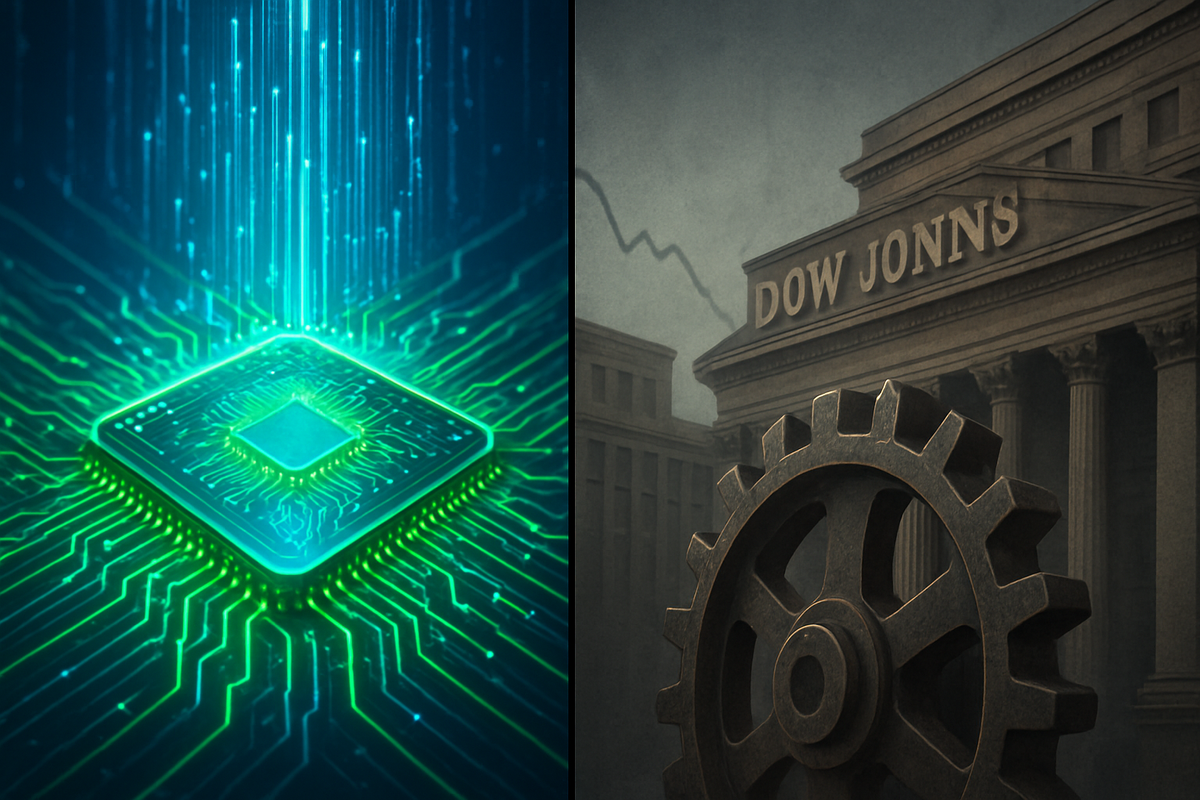
As the opening bell of 2026 rings in a new era of market bifurcation, Nvidia Corp. (Nasdaq: NVDA) continues to demonstrate a singular resilience that has left the broader market in its wake. While the Dow Jones Industrial Average (DJIA) has struggled to maintain momentum in the face of a persistent manufacturing slump and a sudden regulatory shock to the financial sector, Nvidia has surged forward. Trading between $185 and $191 per share, the semiconductor giant is once again flirting with a $4 trillion market capitalization, bolstered by a "sold out" status for its Blackwell chips and the blockbuster unveiling of its next-generation "Rubin" architecture.
The divergence between the "AI Economy" and the "Old Economy" has never been more stark. While the blue-chip Dow has been weighed down by industrial contraction and a proposed 10% cap on credit card interest rates that sent financial heavyweights tumbling, Nvidia has effectively decoupled from these traditional macroeconomic stressors. For investors, the message is clear: the industrialization of artificial intelligence is no longer a speculative trend but a structural shift that is shielding the tech sector’s leaders from the headwinds currently battering traditional industrial and financial giants.
The Rubin Revolution and the Blackwell Boom
The primary catalyst for Nvidia’s early 2026 dominance was the Consumer Electronics Show (CES) held in early January. There, CEO Jensen Huang unveiled the "Rubin" platform, the successor to the already highly successful Blackwell architecture. Named after astronomer Vera Rubin, the new platform introduces the Vera CPU and HBM4 memory, promising a staggering 10x reduction in token costs and five times the inference performance of its predecessor. The Rubin architecture is being built on an advanced 3nm process at TSMC, with the first systems expected to reach cloud providers like Microsoft Corp. (Nasdaq: MSFT) and Amazon.com Inc. (Nasdaq: AMZN) by the second half of 2026.
This announcement comes as the company’s current flagship, the Blackwell chip, remains in a state of chronic undersupply. Management recently confirmed that Blackwell GPUs are effectively sold out through the first half of the year, with demand described as "off the charts." This relentless product cycle—transitioning from a two-year to a one-year release schedule—has allowed Nvidia to maintain a vice-grip on roughly 80% to 92% of the AI accelerator market. The timeline of 2025 was defined by the successful ramp-up of Blackwell, but 2026 is already being characterized by analysts as the "Rubin Revolution," a phase where AI infrastructure moves from experimental clusters to massive "AI factories."
Initial market reactions to the CES announcements were overwhelmingly positive, with the stock jumping nearly 2% on the first trading day of the year. While some "sector-specific cooling" occurred mid-week as investors rebalanced portfolios, the underlying sentiment remains bullish. Wall Street analysts have maintained a 95% "Buy" rating on the stock, with some bull-case price targets reaching as high as $352, suggesting that even at its current multi-trillion-dollar valuation, Nvidia may still have significant room to run.
Winners and Losers: A Tale of Two Markets
The current market environment has created a clear divide between the beneficiaries of the AI build-out and those tethered to the traditional economy. In the "winner" column, Nvidia stands alongside its primary fabrication partner, TSMC, and the "Hyperscalers"—Alphabet Inc. (Nasdaq: GOOGL), Microsoft, and Amazon—who are racing to integrate Rubin-based systems into their data centers. These companies are benefiting from a virtuous cycle where AI demand drives infrastructure spending, which in turn fuels further AI capabilities and software revenue.
Conversely, the "losers" of early 2026 are found within the price-weighted Dow Jones Industrial Average. The financial sector took a massive hit following a January 11 announcement regarding a proposed 10% cap on credit card interest rates. This sent American Express Co. (NYSE: AXP) down over 4%, while JPMorgan Chase & Co. (NYSE: JPM) and Goldman Sachs Group Inc. (NYSE: GS) also faced significant selling pressure. These regulatory hurdles, combined with a 10-month contraction in U.S. manufacturing, have made Dow staples like 3M Co. (NYSE: MMM) and Caterpillar Inc. (NYSE: CAT) unattractive to investors seeking growth.
Even within the technology sector, the divide is visible. "Legacy" tech companies like IBM Corp. (NYSE: IBM) and Salesforce Inc. (NYSE: CRM) have lagged as capital is diverted toward pure-play AI infrastructure. While Salesforce has attempted to find a bottom, it remains a laggard compared to the high-octane growth of the semiconductor space. Meanwhile, UnitedHealth Group Inc. (NYSE: UNH), a massive component of the Dow, continues to struggle with a valuation reset, further dragging down the blue-chip index while Nvidia powers the Nasdaq to new heights.
The Wider Significance: AI Factories and Physical AI
Nvidia’s resilience is more than just a stock market story; it reflects a fundamental shift in the global industrial landscape. The transition to a one-year product cycle is a feat of engineering and supply chain management that has left competitors like Advanced Micro Devices Inc. (Nasdaq: AMD) and Intel Corp. (Nasdaq: INTC) struggling to keep pace. This rapid iteration is necessary to support what Jensen Huang calls "Physical AI"—the application of artificial intelligence to robotics, autonomous systems, and industrial automation.
Historically, market leadership of this magnitude was seen during the dot-com boom or the rise of the PC, but the scale of the "AI factory" movement is unprecedented. Nvidia management forecasts that total demand for AI products through 2026 could exceed $500 billion. This isn't just about chatbots; it's about the "industrialization of intelligence," where every enterprise operates its own AI data center to optimize operations in real-time. This trend is effectively immune to the manufacturing slumps affecting the "Old Economy," as the efficiency gains from AI are often the very solution companies seek during economic downturns.
However, this dominance does not come without risks. The concentration of market power in a single company has invited regulatory scrutiny in the past, and as Nvidia’s valuation rivals the GDP of major nations, the "AI bubble" debate continues to simmer. Yet, with gross margins holding steady at 75%, the company possesses a level of pricing power and financial health that few historical precedents can match.
Looking Ahead: The Road to H2 2026
The short-term outlook for Nvidia is dominated by the transition from Blackwell to Rubin. Investors will be closely watching the H2 2026 rollout to see if Nvidia can maintain its 3nm production yields at TSMC and if the new HBM4 memory supply can keep up with demand. Any hiccups in the supply chain for the Vera CPU or the NVLink 6 interconnect could provide a rare opening for competitors like AMD to gain a foothold in the high-end accelerator market.
In the longer term, the market will be looking for signs of "AI ROI"—proof that the massive capital expenditures by the Hyperscalers are translating into tangible bottom-line growth. If Microsoft and Google can demonstrate that their AI-driven software suites are generating the expected returns, it will provide the fundamental justification for Nvidia’s next leg up. Conversely, if corporate AI spending begins to plateau, Nvidia may finally face the "sector-specific cooling" that bears have been predicting for years.
Closing Thoughts for Investors
As of mid-January 2026, Nvidia remains the undisputed king of the market, proving that innovation can trump macroeconomic malaise. While the Dow Jones Industrial Average grapples with interest rate caps, manufacturing declines, and geopolitical friction in the energy sector, Nvidia is operating in a world of its own making. The "Rubin Revolution" has set the stage for another year of technological leaps that could redefine the global economy.
For investors, the key takeaways are the importance of market breadth and the risks of index concentration. While Nvidia’s gains have been spectacular, the lagging performance of the Dow's industrial and financial components suggests a fragile broader economy. In the coming months, watch for the H200 sales data from China and the Supreme Court’s ruling on trade tariffs, both of which could introduce volatility into an otherwise stellar growth story. For now, the AI juggernaut shows no signs of slowing down.
This content is intended for informational purposes only and is not financial advice.