
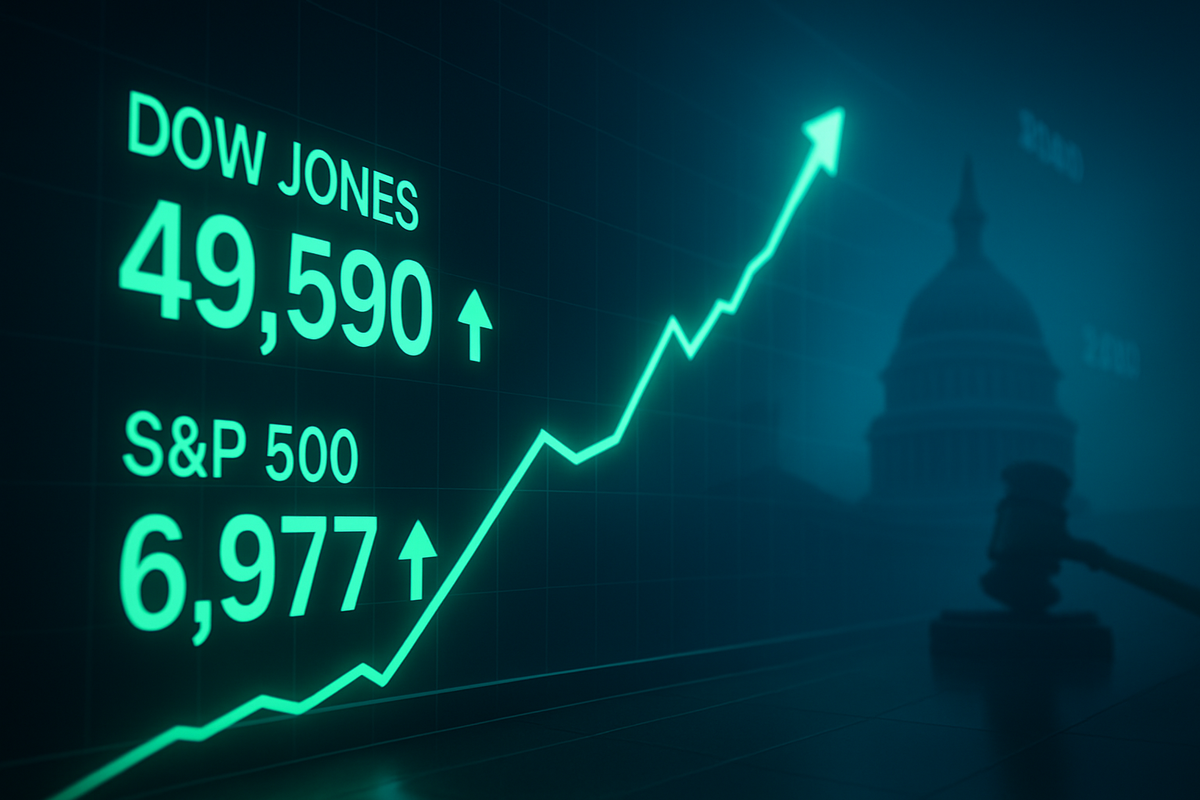
In a stunning display of resilience, the U.S. stock market surged to unprecedented levels on January 12, 2026, as both the S&P 500 and the Dow Jones Industrial Average (DJIA) notched fresh closing records. Investors appeared to decouple from a swirl of political and regulatory uncertainty, focusing instead on a robust "January Barometer" and a massive breakout in technology infrastructure. The Dow Jones Industrial Average closed at a record 49,590, while the S&P 500 finished the day at 6,977.27, leaving the psychological milestones of 50,000 and 7,000 within striking distance.
The rally is particularly notable for its timing, occurring just as the Department of Justice initiated a high-profile investigation into Federal Reserve Chair Jerome Powell. While the "Powell Probe" initially sent shockwaves through the trading floor—triggering a 500-point intraday drop in the Dow—the market’s rapid recovery suggests a deep-seated belief that the underlying economic engine remains insulated from Washington’s legal battles. This "melt-up" scenario, fueled by a transition from speculative AI hype to tangible infrastructure investment, has left many analysts recalibrating their year-end targets.
A Historic Opening to 2026
The path to today’s records began in the first trading week of the year, following a rare "bullish trifecta." The market successfully completed a Santa Claus Rally, a positive "First Five Days," and is currently on track to fulfill the "January Barometer"—a sequence that historically correlates with an 86% probability of a positive annual return. On January 6, the Dow breached 49,000 for the first time, setting the stage for the volatility that followed. The technical significance of this move cannot be overstated; analysts pointed to a "massive wedge formation" that had been tightening since late 2025. The breakout from this pattern suggests that the current momentum is not merely a fluke but a structural shift in market sentiment.
The timeline of the past 48 hours has been especially frantic. Over the weekend of January 10-11, a dual-pronged political storm hit the wires. First, President Trump called for a 10% cap on credit card interest rates, a move designed to court populist favor but one that immediately pressured the financial sector. Simultaneously, news broke of the DOJ’s criminal investigation into Chair Powell regarding historical testimony on building renovations. Despite these headwinds, the market’s dip on the morning of January 12 was met with aggressive "buy the dip" activity, as institutional investors bet that the Fed’s trajectory for interest rate cuts would remain unchanged by the personal legal challenges of its leadership.
Winners and Losers in the Infrastructure Shift
The primary drivers of this record-breaking session were the "Silicon Backbone" companies—those providing the hardware necessary for the next phase of the AI revolution. Leading the charge was SanDisk (NASDAQ: SNDK), which saw its shares soar 28% following reports of a supply-chain breakthrough. Micron Technology (NASDAQ: MU) and Western Digital (NASDAQ: WDC) also posted significant gains, as the market pivoted away from general software applications toward data storage and semiconductor manufacturing. Broadcom (NASDAQ: AVGO) added to the momentum, rallying after the announcement of "Project Titan," a collaborative effort with OpenAI to build dedicated sovereign AI chips.
Conversely, the financial sector faced a grueling session. The proposed 10% cap on credit card interest rates sent shares of Capital One Financial (NYSE: COF) and Synchrony Financial (NYSE: SYF) tumbling by 6% and 7%, respectively. Investors are weighing the potential for a massive contraction in net interest margins against the possibility that such a cap may never pass legislative or judicial muster. Meanwhile, the transportation sector provided a bright spot; Southwest Airlines (NYSE: LUV) surged following a major upgrade, and Allegiant Travel Company (NASDAQ: ALGT) saw its shares rise after announcing a $1.5 billion acquisition of Sun Country Airlines (NASDAQ: SNCY), signaling a wave of consolidation in the low-cost carrier space.
Broadening Breadth and Historical Context
The current rally is distinguished from the "Magnificent Seven" dominance of 2025 by its broadening participation. The Russell 2000 index, representing small-cap stocks, has jumped over 5% in the first two weeks of January, indicating that the bull market is finally trickling down to more sensitive areas of the economy. This shift mirrors the networking and hardware boom of the late 1990s, where the "picks and shovels" of the internet outpaced the early dot-com pioneers. However, the technical indicators also flash a warning sign: the Shiller CAPE ratio for the S&P 500 has now topped 40, a level previously seen only during the 2000 tech peak.
The market is also pricing in a "buy the rumor" scenario regarding a pending Supreme Court ruling on the "Liberation Day" tariffs imposed in April 2025. Analysts suggest that if the court strikes down these tariffs, the S&P 500 could see an immediate 2.4% boost in aggregate earnings. This expectation of regulatory relief, combined with a proposed $1.5 trillion military budget that has buoyed defense giants like Lockheed Martin (NYSE: LMT) and Northrop Grumman (NYSE: NOC), has created a "perfect storm" of optimism that appears to be drowning out the noise of the DOJ's investigation into the Federal Reserve.
The Road to 50,000 and Beyond
Looking ahead, the market faces several critical "junction points." In the short term, all eyes remain on the 50,000 mark for the Dow and 7,000 for the S&P 500. If these levels are breached with high volume, technical analysts foresee a "melt-up" toward 7,500 or even 8,000 for the S&P 500 by mid-year. However, the legal fate of Chair Powell and the potential for a constitutional crisis between the White House and the Fed could introduce sudden, sharp volatility. Strategic pivots may be required for investors who have been overweight in financials, especially if the credit card interest rate cap gains political traction.
The long-term outlook will depend heavily on whether the "AI Infrastructure" play can deliver on the massive earnings expectations baked into current valuations. While the capture of Venezuelan President Nicolás Maduro on January 5 has provided a temporary boost to energy stocks and hopes for future oil access, the sustainability of the broader rally hinges on the Supreme Court’s tariff decision. A ruling against the administration could provide the next leg of the rally, while an upholding of the tariffs might trigger a "sell the news" event that tests the market's newfound floors.
Investor Takeaway: Watching the Pillars
As of January 12, 2026, the U.S. markets stand at a historic crossroads. The S&P 500 and Dow have demonstrated an almost uncanny ability to ignore political friction in favor of technical momentum and sector-specific growth. The key takeaway for investors is the shift in leadership; the market is no longer a monolith driven by a few tech titans but is instead a more complex ecosystem where infrastructure, defense, and even small-caps are finding their footing.
Moving forward, the market's health will be measured by its ability to maintain these record levels in the face of the "Powell Probe" and the upcoming judicial rulings. Investors should watch for the Dow to cross the 50,000 threshold as a sign of continued psychological dominance. While the Shiller CAPE ratio suggests we are in overextended territory, the "January Indicator Trifecta" provides a powerful historical tailwind. For now, the bulls are firmly in control, but the coming months will determine if this is a sustainable climb or a final peak before a long-overdue correction.
This content is intended for informational purposes only and is not financial advice.