
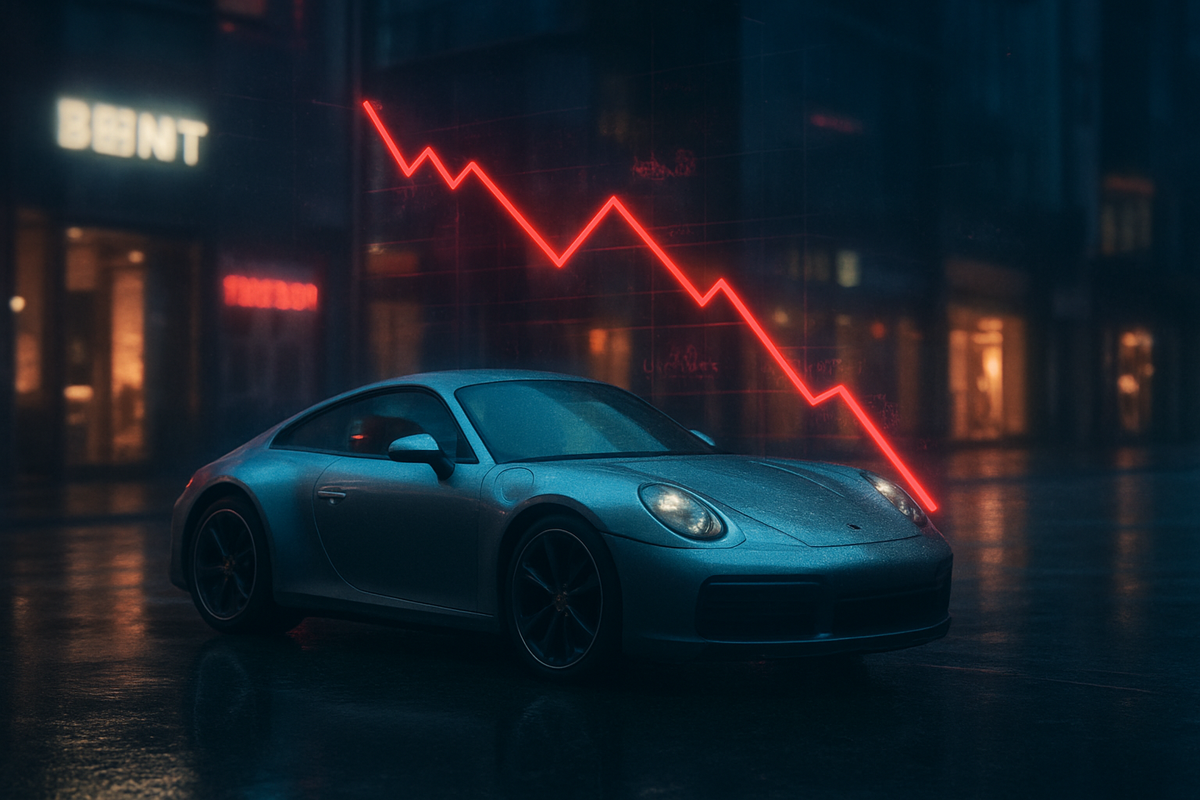
The premium automotive sector faced a stark reality check on January 12, 2026, as shares of Porsche AG (XETRA: P911) tumbled 7% in a single trading session. The sell-off, which wiped billions off the iconic carmaker’s market capitalization, was triggered by a wave of analyst downgrades and a growing consensus that the company’s recovery trajectory for 2026 is far more fragile than previously signaled by management.
Investors are increasingly wary of a "perfect storm" hitting the Stuttgart-based manufacturer: a widening product gap in its lineup, structural demand shifts in its most profitable market, China, and the lingering sting of transatlantic trade tariffs. As the market reassesses Porsche’s growth prospects, the drop signals a broader cooling of the luxury goods sector, where the post-pandemic "revenge spending" era has been replaced by cautious consumer behavior and a pivot toward experiential luxury.
The catalyst for the January 12 slide was a high-profile downgrade from Barclays, which shifted its rating on Porsche AG (XETRA: P911) from "Equalweight" to "Underweight." Analysts at the firm slashed their price target to €40.00, arguing that the market’s valuation of the company—trading at over 20 times its 2026 earnings estimates—was fundamentally misaligned with its realistic growth potential. The downgrade highlighted a critical "product gap" emerging in early 2026; following the phase-out of the internal combustion engine (ICE) versions of the Macan and the 718 series, Porsche finds itself in a volume vacuum.
The timeline leading to this moment has been fraught with challenges. Throughout late 2025, Porsche management had attempted to frame the year as the "trough" of its earnings cycle, promising a robust rebound in 2026. However, by the first week of January 2026, it became clear that the anticipated surge in Battery Electric Vehicle (BEV) adoption was not materializing as planned. Instead, the company was forced to navigate the August 2025 implementation of a 15% US import tariff on luxury vehicles, which necessitated aggressive price hikes and tested the brand loyalty of its North American customer base.
Key stakeholders, including the Porsche and Piëch families and majority owner Volkswagen AG (XETRA: VOW3), are now facing pressure to address the company’s revised margin targets. While Porsche once boasted a medium-term ambition of 17% to 19% operating margins, analysts are now forecasting a much leaner 10% to 15% for the 2026 fiscal year. This recalibration reflects the high "flexibility costs" of maintaining both ICE and electric production lines simultaneously as the global transition to EVs hits a significant plateau.
The primary loser in this shift is undoubtedly Porsche AG (XETRA: P911), which has seen its "luxury premium" valuation eroded. The company is struggling to maintain its status as a high-margin outlier compared to other German OEMs like BMW (XETRA: BMW) and Mercedes-Benz (XETRA: MBG). While BMW and Mercedes have traded at significantly lower multiples for years, their more diversified portfolios and established hybrid offerings are now being viewed by some investors as a safer harbor during the current luxury downturn.
Conversely, the winners in this scenario appear to be the rising stars of the Chinese premium EV market. Companies such as Li Auto (NASDAQ: LI), Xiaomi (HKEX: 1810), and Zeekr (NYSE: ZK) have successfully capitalized on the softening demand for European legacy brands in China. By offering high-tech, digitally integrated luxury experiences at competitive price points, these domestic players are capturing the younger demographic that Porsche once dominated. This structural shift in China—historically Porsche’s most profitable region—suggests that the German carmaker may never fully reclaim its former market share.
In the broader financial landscape, luxury conglomerates like LVMH (Euronext: MC) and Kering (Euronext: KER) are also feeling the ripple effects. The reassessment of Porsche’s growth is being taken as a proxy for the entire high-end consumer sector. If a brand as resilient and aspirational as Porsche is seeing a 7% drop due to earnings concerns, it signals to the market that the "aspirational luxury" buyer is under significant financial strain globally, particularly in Europe and Asia.
The current crisis at Porsche fits into a wider industry trend of "luxury normalization." After years of unprecedented growth, the luxury automotive market is grappling with a shift in consumer priorities. Data from early 2026 suggests that wealthy individuals are increasingly choosing "experience over goods," allocating capital toward high-end hospitality and travel rather than traditional status symbols like sports cars. This generational shift, led by Millennials and Gen Z who now represent a majority of luxury buyers, emphasizes tech-forward utility over mechanical heritage.
Furthermore, the BEV plateau has created a regulatory and strategic headache for European carmakers. Porsche’s pivot back toward hybrid models to satisfy lingering ICE demand has incurred massive restructuring costs. This mirrors the challenges faced by partners and competitors alike, as the industry realizes that the "all-electric" future is arriving much slower than policy mandates originally envisioned. The 2025 US tariffs have only added fuel to the fire, marking a return to protectionist policies that disrupt global supply chains and force localized production—a difficult feat for a brand that prides itself on its "Made in Germany" pedigree.
Historical precedents, such as the luxury slowdown of 2008 and the 2015 Chinese market volatility, suggest that recovery for brands like Porsche often depends on a "super-cycle" of new product launches. However, unlike previous cycles, Porsche’s next major "prestige" SUV and mid-size electric models are not slated for meaningful delivery until 2027 or 2028. This leaves the company in a precarious two-year holding pattern, during which it must defend its margins without the benefit of fresh, high-volume models.
In the short term, Porsche will likely need to implement a more aggressive cost-cutting program to protect its remaining margins. Investors should expect a strategic pivot in the company’s marketing, moving away from volume targets and doubling down on "ultra-exclusive" limited editions and bespoke "Sonderwunsch" (special request) programs. These high-margin, low-volume offerings could serve as a financial bridge until the next generation of SUVs arrives in late 2027.
Long-term, the company faces a fundamental question of identity. To regain its footing, Porsche may need to accelerate its software and tech integration to compete with Chinese rivals, potentially seeking new partnerships in the Silicon Valley or Shenzhen tech ecosystems. The market will be watching closely for any signs of a recovery in the Chinese economy or a softening of US trade stances, both of which would provide a much-needed tailwind for the stock.
Scenario-wise, if Porsche can maintain its brand equity through this "product gap" without resorting to heavy discounting, it may emerge as a leaner, more resilient entity by 2028. However, if the luxury cooling deepens into a prolonged global recession, the company may be forced to further revise its 2026 EPS estimates, which currently sit at a modest €2.39. Market opportunities may emerge for value investors if the stock price continues to fall toward the €40.00 mark, though the risks remains high until the 2027 product roadmap becomes clearer.
The 7% drop in Porsche’s share price on January 12, 2026, serves as a definitive signal that the luxury automotive sector is entering a period of significant recalibration. The combination of a cooling Chinese market, the transition hurdles of electrification, and a shift in global consumer spending has stripped away the invincibility that Porsche seemed to enjoy post-IPO. The "product gap" identified by analysts is now the central challenge for the company, leaving it vulnerable to more agile competitors in the near term.
Moving forward, the market will remain volatile as investors weigh Porsche’s heritage against the harsh realities of 2026’s economic landscape. The key takeaways for investors are clear: the path to 17% margins is longer and more arduous than expected, and the "China factor" has permanently changed from a growth engine to a structural headwind.
In the coming months, stakeholders should watch for quarterly delivery reports from China and any updates regarding the 2027 SUV pipeline. While the Porsche brand remains one of the most powerful in the world, the next two years will be a test of whether that brand power can withstand a shifting global order that increasingly values bits and bytes as much as pistons and cylinders.
This content is intended for informational purposes only and is not financial advice.