

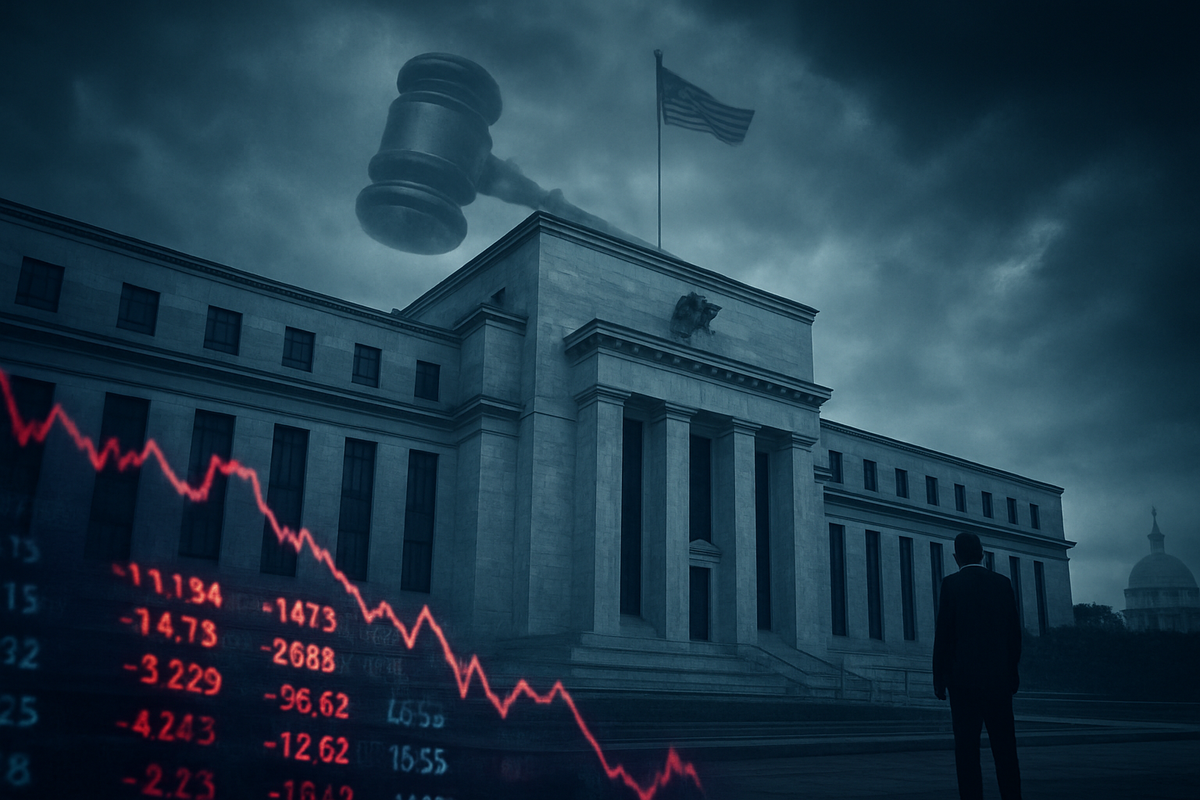
The long-standing tension between the executive branch and the nation’s central bank reached a boiling point this week as the U.S. Department of Justice (DOJ) launched a formal criminal investigation into Federal Reserve Chair Jerome Powell. The probe, which centers on allegations of perjury regarding a multi-billion dollar renovation of the Fed’s headquarters, has sent shockwaves through global financial centers. On Monday, January 12, 2026, the Dow Jones Industrial Average plummeted 444 points at the opening bell, reflecting deep-seated investor anxiety over the potential erosion of the Federal Reserve's institutional independence.
The immediate implications of this investigation are profound, as it introduces a "political risk premium" into U.S. assets that was previously reserved for emerging markets. With Powell’s term as Chair set to expire in May 2026, the investigation is widely viewed by market participants as an aggressive maneuver to force his early exit or undermine his authority. The resulting volatility has seen a massive flight to safety, with gold prices hitting historic highs while banking stocks face a double-edged sword of regulatory uncertainty and political interference.
The Perjury Probe: A Timeline of Escalation
The current crisis began in earnest on Friday, January 9, 2026, when the Federal Reserve was served with grand jury subpoenas by the U.S. Attorney’s Office for the District of Columbia. The investigation, led by U.S. Attorney Jeanine Pirro, focuses on Powell’s testimony before the Senate Banking Committee on June 25, 2025. During that hearing, Powell was questioned about the $2.5 billion renovation of the Marriner S. Eccles Building. Critics, led by OMB Director Russell Vought and House Representative Anna Paulina Luna, allege that Powell misled Congress by denying the existence of "lavish" features in the project, such as VIP private dining rooms and premium marble finishes.
In an unprecedented move, Chair Powell released a video statement on Sunday, January 11, 2026, to address the public directly. He characterized the investigation as a "pretext" aimed at punishing the Federal Reserve for its refusal to align monetary policy with the administration's political agenda. Powell asserted that the threat of criminal charges is a direct consequence of the Fed setting interest rates based on economic data rather than executive preference. This public defiance has set the stage for a historic legal battle between the central bank and the Justice Department.
The timeline of this friction dates back to mid-2025, when the administration began increasing its rhetoric against the Fed’s "higher-for-longer" interest rate stance. The $2.5 billion renovation project, which involves complex engineering to lower the building's slab and modernize its infrastructure, became a convenient focal point for political attacks. While the Fed maintains that the costs are justified by the age and historical significance of the buildings, the DOJ is now scrutinizing internal project plans submitted to the National Capital Planning Commission (NCPC) to find discrepancies with Powell’s sworn testimony.
Market Fallout: Winners and Losers in a Volatile Climate
The banking sector has borne the brunt of the market’s negative reaction. Major financial institutions saw their share prices tumble as the investigation coincided with administration threats to cap credit card interest rates at 10%. Synchrony Financial (NYSE: SYF) led the decline, dropping 10%, followed closely by Capital One Financial Corp (NYSE: COF) and American Express (NYSE: AXP). Large-scale lenders like JPMorgan Chase & Co. (NYSE: JPM), Bank of America Corp (NYSE: BAC), and Citigroup Inc. (NYSE: C) also saw significant sell-offs as investors feared a more politicized and less predictable regulatory environment.
Construction and engineering firms tied to the controversial renovation are also under the microscope. Balfour Beatty (LSE:BBY), which is part of the joint venture managing the $2.5 billion project, has seen its stock impacted by the negative publicity and the potential for contract freezes or audits. The investigation into "lavish" features and cost overruns puts these contractors in a difficult position, as they may be called to provide testimony or documentation that could either exonerate or further implicate the Fed leadership.
Conversely, the "flight to safety" trade has created clear winners. Gold prices surged past $4,600 per ounce for the first time in history, providing a massive boost to mining companies. Newmont Corporation (NYSE: NEM) and Barrick Gold Corp (NYSE: GOLD) both saw substantial gains as investors sought refuge from the weakening U.S. dollar and the uncertainty surrounding U.S. Treasury yields. Interestingly, Alphabet Inc. (NASDAQ: GOOGL) managed to reach a $4 trillion market cap on the same day, though analysts attribute this more to its recent AI partnerships than to the broader macroeconomic turmoil.
The Erosion of Independence and Global Precedents
This investigation fits into a broader global trend of executive branches attempting to exert control over nominally independent central banks. Economists have noted that the DOJ’s move resembles tactics used in nations with weaker institutional frameworks, where legal probes are used to sideline technocrats who disagree with the ruling party. The 10-year Treasury yield spiked to 4.20% on Monday, a clear signal that global bondholders are demanding a higher yield to compensate for the perceived increase in U.S. political instability.
The regulatory implications are staggering. If a sitting Fed Chair can be subjected to a criminal probe over administrative testimony, it sets a precedent that could permanently alter how the Federal Reserve operates. A bipartisan group of former Fed chairs and Treasury secretaries has already issued a statement warning that this "weaponization of the legal system" threatens the very foundation of the U.S. economy. They argue that without a credible, independent central bank, the U.S. risks losing its status as the world’s primary reserve currency and a bastion of financial stability.
Historical comparisons are being drawn to the Nixon era, where pressure was famously applied to then-Chair Arthur Burns, though never through the direct threat of a criminal perjury investigation. The current situation is unique in its intensity and its use of the Justice Department as a primary tool of influence. This shift suggests a new era of "fiscal dominance" where monetary policy is no longer insulated from the short-term whims of the electoral cycle.
The Road Ahead: Strategic Pivots and Scenarios
In the short term, the market will remain hyper-sensitive to any leaks from the grand jury or further statements from the U.S. Attorney’s Office. Powell has vowed to remain in his seat as a Governor until his full term expires in 2028, even if he is not reappointed as Chair this coming May. This creates a potential "lame duck" scenario where the leader of the Fed is under active investigation while trying to navigate an economy still dealing with the tail-end of inflationary pressures.
Strategic pivots are already occurring within the halls of Congress. Senators like Thom Tillis and Lisa Murkowski have indicated they may block any future Fed nominees until the DOJ probe is concluded, potentially leading to a gridlocked Board of Governors. For investors, this means that "Fed speak" will become even more scrutinized for signs of political capitulation or renewed defiance. The possibility of a "shadow Fed" emerging—where markets look to other governors or even international central banks for guidance—is no longer a fringe theory.
Long-term, the outcome depends on whether the DOJ can produce a "smoking gun" regarding the renovation project. If the probe is seen as a failure or a purely political exercise, it could lead to a massive relief rally and a strengthening of the Fed’s mandate. However, if charges are brought, the U.S. could face a protracted constitutional crisis that would likely keep volatility elevated for years to come.
Summary and Investor Outlook
The DOJ’s investigation into Jerome Powell represents a watershed moment for the American financial system. It is no longer just about interest rates or inflation targets; it is about the fundamental structure of the U.S. government and its relationship with the markets. The key takeaways for investors are the heightened political risk premium now attached to U.S. assets and the clear divergence between "safe haven" commodities and "at-risk" financial stocks.
Moving forward, the market will likely remain in a "wait-and-see" mode, with every court filing and congressional hearing serving as a potential catalyst for a sell-off. Investors should keep a close eye on gold prices as a barometer of institutional trust and watch for any signs of a unified front from the Fed’s Board of Governors. The coming months will determine whether the Federal Reserve remains the world's most powerful independent economic actor or becomes another department subject to the political winds of Washington.
This content is intended for informational purposes only and is not financial advice.