
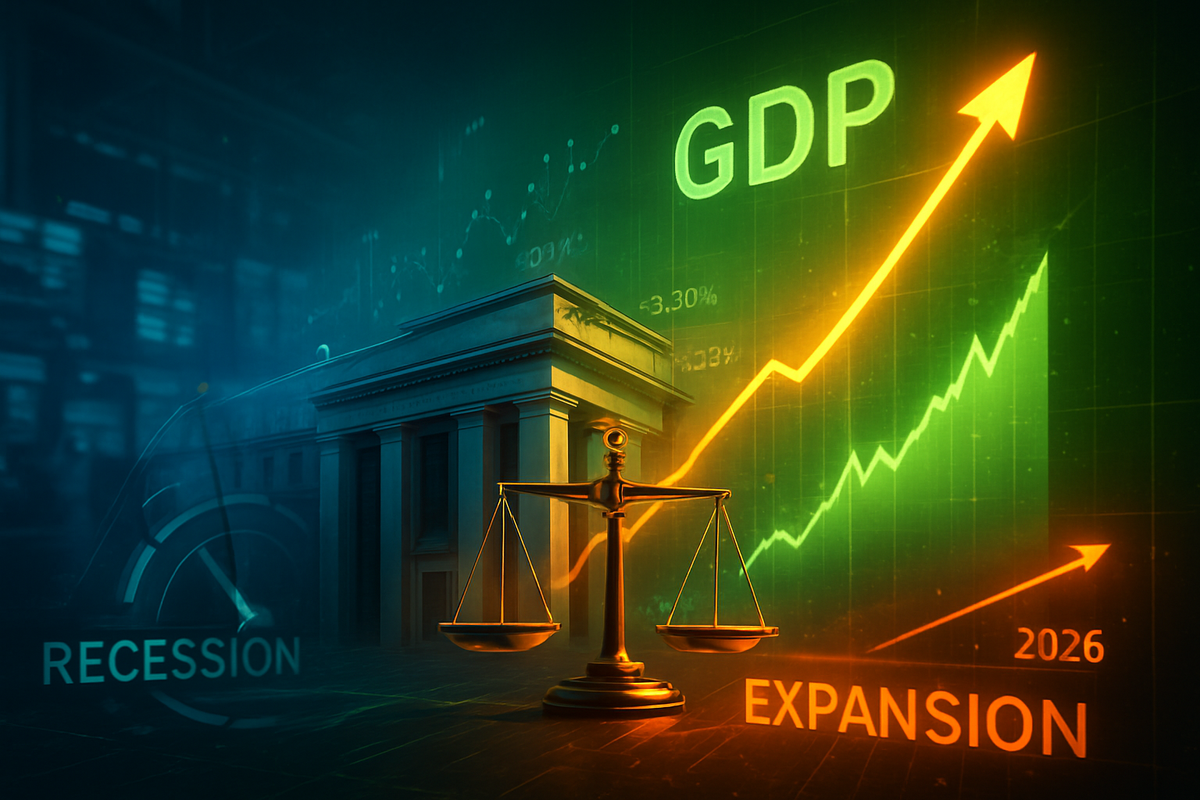
As the final week of 2025 draws to a close, the financial markets are grappling with a fundamental shift in expectations that has upended investment strategies for the coming year. What began the year as a cautious march toward a "soft landing" has transformed into a high-octane "no-landing" scenario, fueled by a massive upside surprise in economic growth. This "Market Narrative Flip" has forced a dramatic repricing of the 2026 interest rate path, moving the conversation from how many cuts the Federal Reserve will deliver to whether the easing cycle is already nearing its end.
The catalyst for this shift arrived in late December, as a series of "blowout" data points suggested that the U.S. economy is not merely resilient, but accelerating. With the Federal Reserve signaling a more hawkish stance for 2026, investors are now recalibrating their portfolios to account for a "higher-for-longer" plateau that few saw coming just three months ago. The implications are profound, creating a stark divide between sectors poised to thrive in a high-growth, high-rate environment and those that remain tethered to the era of cheap capital.
The December Data Shock and the Fed’s "Hawkish Cut"
The turning point occurred on December 23, 2025, when the Bureau of Economic Analysis (BEA) released its final reading for third-quarter GDP. The figures were nothing short of extraordinary: the U.S. economy expanded at an annualized rate of 4.3% in Q3, far exceeding the consensus estimate of 3.2%. This growth was propelled by a 3.5% surge in consumer spending and a massive 8.8% spike in exports. Even more surprising was the resilience of the fourth quarter; despite a 43-day federal government shutdown in October and November, retail sales and employment data bounced back with unexpected vigor in December, suggesting the "data vacuum" had hidden an underlying economic boom.
In response to this momentum, the Federal Open Market Committee (FOMC) meeting on December 10, 2025, delivered what many are calling a "Hawkish Cut." While the Fed did lower the federal funds rate by 25 basis points to a range of 3.50% to 3.75%, the accompanying "Dot Plot" sent shockwaves through the bond market. The median projection now signals only one additional 25-basis-point cut for the entirety of 2026, targeting a terminal rate of 3.25% to 3.50%. This is a significant departure from earlier in the year, when markets were pricing in as many as four cuts for 2026. The 10-year Treasury yield responded by climbing toward 4.20%, as the market accepted that the "neutral rate" may be much higher than previously thought.
Winners and Losers: The New Market Bifurcation
This narrative flip has created a clear set of winners in the equity markets. The banking sector has emerged as a primary beneficiary, as the steepening yield curve and higher-for-longer rates bolster net interest margins. JPMorgan Chase & Co. (NYSE: JPM) and Bank of America Corp. (NYSE: BAC) have seen their outlooks revised upward, with JPMorgan projected to hit a record $94 billion in net interest income for 2025. Similarly, the Russell 2000 index of small-cap stocks hit fresh records in late December, as domestic-focused companies benefit from the "expansion acceleration" and the passage of the "One Big Beautiful Bill Act," a major fiscal stimulus package that has spurred industrial activity.
Conversely, interest-rate-sensitive sectors are feeling the squeeze. Real estate investment trusts (REITs), particularly those in the industrial and office spaces, have faced significant headwinds. Prologis Inc. (NYSE: PLD) saw its valuation multiples pressured as the prospect of fewer rate cuts in 2026 increased the long-term cost of capital. The office sector remains in a structural slump, with firms like Vornado Realty Trust (NYSE: VNO) struggling under the weight of high retrofitting costs and a higher-than-expected neutral rate. Even high-growth technology giants like NVIDIA Corp. (NASDAQ: NVDA) and Microsoft Corp. (NASDAQ: MSFT), while still buoyed by AI demand, have experienced increased volatility as higher discount rates are applied to their future cash flows.
Broader Significance: AI Productivity and the "No-Landing" Risk
The current shift fits into a broader trend of "AI-driven productivity" that many economists, including Jan Hatzius of Goldman Sachs Group Inc. (NYSE: GS), believe is permanently altering the U.S. growth trajectory. The "Market Narrative Flip" is not just about a temporary spike in GDP; it represents a growing belief that the U.S. economy has entered a new era of higher potential growth. This has led to comparisons with the late 1990s, where technological innovation allowed for strong growth without immediate inflationary spikes, though the current "sticky" inflation rate of 2.5% to 3.0% remains a point of concern for the Fed.
However, the "no-landing" scenario carries its own set of risks. Torsten Sløk of Apollo Global Management has warned that the Fed may be forced to hold rates at these restrictive levels for the foreseeable future if inflation does not settle at the 2% target. This creates a "policy crosswind" where the Fed’s desire to normalize rates is constantly being thwarted by an economy that refuses to slow down. The ripple effects are being felt globally, as the strong U.S. dollar—driven by high domestic rates—puts pressure on emerging markets and forces other central banks to reconsider their own easing cycles.
What Comes Next: The 2026 Outlook
Looking ahead to early 2026, the primary question for investors is whether the Fed will pause its easing cycle sooner than expected. Many analysts now anticipate a "wait-and-see" approach for the January 2026 FOMC meeting, with a final "insurance cut" possibly occurring in March. If the Q4 2025 GDP data, expected in late January, confirms the 4%+ growth trend, the Fed may abandon rate cuts altogether for the remainder of the year. This would require a significant strategic pivot for fixed-income investors, who may need to move away from long-duration bonds and toward shorter-term instruments or inflation-protected securities.
Market opportunities are likely to emerge in cyclical industries such as energy and industrials, which stand to gain from sustained economic expansion. However, the challenge will be navigating the "valuation trap" in high-beta sectors. As the 2026 interest rate path becomes clearer, the market will likely reward companies with strong balance sheets and the ability to generate cash flow without relying on cheap credit. The "Goldilocks" environment of 2025—where growth was good but rates were falling—is being replaced by a more disciplined "Expansion Era" where growth is great, but capital has a cost.
Summary and Final Thoughts
The "Market Narrative Flip" of late 2025 marks a definitive end to the recession fears that dominated the early part of the decade. With a blowout 4.3% GDP growth rate and a Federal Reserve that is recalibrating for a higher-rate future, the investment landscape has been fundamentally altered. Key takeaways for the coming months include the continued dominance of large-cap banks and domestic small-caps, the ongoing struggle for rate-sensitive real estate, and the overarching influence of AI on national productivity.
As we move into 2026, investors should keep a close watch on the January jobs report and the first preliminary reading of Q4 GDP. These data points will determine if the current "no-landing" momentum is sustainable or if the "Hawkish Cut" of December was a premature reaction. For now, the narrative is clear: the U.S. economy is charging forward, and the era of "free money" is a distant memory. The market has flipped, and those who fail to adapt to the new 2026 rate path risk being left behind in the wake of this historic expansion.
This content is intended for informational purposes only and is not financial advice.