
In a move that underscored the Federal Reserve’s delicate balancing act, the Federal Open Market Committee (FOMC) concluded its final meeting of 2025 on December 10 by delivering a widely anticipated 25-basis-point interest rate cut. This marks the third consecutive quarter-point reduction this year, bringing the federal funds rate to a target range of 3.50% to 3.75%. However, the immediate reaction in the financial markets was far from celebratory. Instead of focusing on the lower borrowing costs, investors were rattled by a surprisingly "hawkish" message embedded in the Fed’s economic projections and Chair Jerome Powell’s cautious rhetoric.
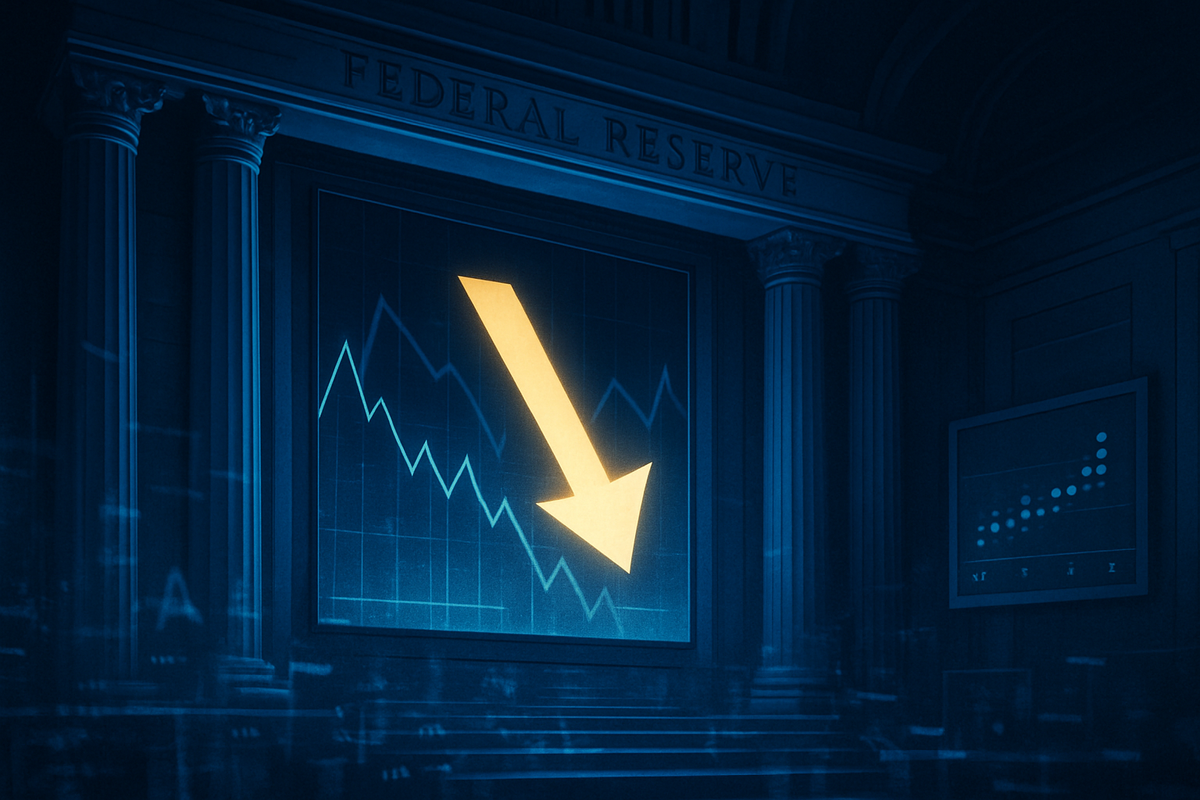
The disconnect between the rate cut and the market’s reaction stems from the Fed’s updated "Dot Plot," which signaled a sharp departure from the aggressive easing cycle many traders had anticipated for the coming year. By suggesting that the central bank might only implement one additional cut in all of 2026, the Fed effectively placed a floor under interest rates, sparking a rapid repricing in the futures markets. As of December 26, 2025, the fallout continues to ripple through global markets, as participants grapple with the reality that the era of ultra-low rates remains a distant memory.
A Divided Fed and the "Data Void"
The December 10 decision was notable not just for the cut itself, but for the deep internal division it revealed within the FOMC. The 9–3 vote represented the most significant dissent the committee has seen in over five years. Governor Stephen Miran led the charge for a more aggressive 50-basis-point "jumbo" cut, citing emerging "cracks" in the labor market and the need to stay ahead of a potential slowdown. On the other end of the spectrum, regional presidents Austan Goolsbee of Chicago and Jeffrey Schmid of Kansas City voted to hold rates steady, expressing concerns that inflation—currently hovering around 2.4%—remains too sticky to warrant further easing.
This internal friction played out against a backdrop of significant uncertainty. The U.S. economy recently emerged from a 43-day federal government shutdown in October, which created a "data void" by delaying critical employment and inflation reports. Chair Jerome Powell described the current economic picture as "clear as mud," explaining that the Fed was forced to rely on private-sector proxies like ADP and anecdotal evidence from the Beige Book. To further complicate matters, the Fed simultaneously announced a resumption of Reserve Management Purchases (RMPs), pledging to buy $40 billion in T-bills per month starting December 12. While intended to stabilize the repo market following the shutdown, some analysts have characterized this as a form of "stealth QE" to ensure liquidity during a period of heavy Treasury issuance.
Winners and Losers: Banking Stability vs. Growth Volatility
The Fed’s shift toward a "higher-for-longer" plateau has created a bifurcated landscape for public companies. Traditional financial institutions like JPMorgan Chase & Co. (NYSE: JPM) and Bank of America Corp. (NYSE: BAC) emerged as relative winners. The hawkish signal for 2026 helped steepen the yield curve, which generally boosts net interest margins—the difference between what banks earn on loans and what they pay on deposits. With the Fed signaling that it is nearing its "neutral rate," these banks can look forward to a more predictable environment for lending and capital allocation.
Conversely, high-growth technology firms and interest-rate-sensitive sectors faced immediate pressure. Companies like NVIDIA Corp. (NASDAQ: NVDA) and Microsoft Corp. (NASDAQ: MSFT), whose valuations are heavily dependent on discounting future cash flows at lower rates, saw increased volatility as long-term Treasury yields climbed in response to the Fed's dot plot. Similarly, the real estate sector, represented by giants like Prologis Inc. (NYSE: PLD), faced a setback. The prospect of fewer rate cuts in 2026 means that mortgage and construction loan rates are unlikely to fall as significantly as previously hoped, potentially cooling the recovery in the commercial and residential property markets.
The Broader Significance: The "Last Mile" of Inflation
The Fed's December stance reflects a broader industry trend known as the "last mile" of inflation control. While the central bank has successfully brought inflation down from its 2022 peaks, the final descent to the 2% target is proving difficult. This event mirrors the late 1990s, where the Fed attempted a "soft landing" by fine-tuning rates rather than slashing them. The current policy shift suggests that the Fed believes the "neutral rate"—the interest rate that neither stimulates nor restrains the economy—is higher than it was in the pre-pandemic era.
Furthermore, the hawkish message serves as a defensive hedge against potential policy shifts from the incoming administration. With discussions of new tariffs and fiscal expansion on the horizon for 2026, the Fed is signaling that it will not hesitate to pause its easing cycle if inflationary pressures re-emerge. This regulatory caution has significant ripple effects on international markets, as a stronger U.S. dollar—buoyed by higher relative interest rates—puts pressure on emerging market economies and global trade partners.
What Comes Next: A January Pause?
As we move into the early weeks of 2026, the primary question for investors is whether the Fed will move to the sidelines. Futures markets have already slashed the probability of a January rate cut to below 20%, a stark contrast to the 60% probability seen just a month ago. Short-term, the market will be hyper-focused on the "catch-up" data expected in January as government agencies release the backlog of reports delayed by the shutdown. If these reports show a resilient labor market, the Fed's hawkish pivot will be vindicated; if they show significant weakness, the committee may face renewed pressure to reconsider its 2026 outlook.
In the long term, strategic pivots will be required for both corporate leaders and investors. Companies will need to move away from the "waiting for lower rates" strategy and instead focus on operational efficiency and organic growth. We may see a slowdown in the frenetic pace of tech IPOs and a renewed interest in value-oriented stocks that offer strong dividends and stable cash flows. The "higher-for-now" environment will test the resilience of companies with high debt loads, potentially leading to a wave of refinancing or restructuring in the mid-cap sector.
Closing Thoughts: Navigating the New Neutral
The Federal Reserve’s December 2025 meeting will likely be remembered as the moment the central bank "called time" on the post-inflation easing cycle. By delivering a cut while simultaneously lowering expectations for future moves, the Fed has successfully regained control of the narrative, even at the cost of short-term market stability. The key takeaway for investors is that the "Fed Put"—the idea that the central bank will always step in with lower rates to support markets—has been significantly recalibrated.
Moving forward, the market is entering a phase where economic fundamentals will matter more than monetary policy headlines. Investors should keep a close eye on the PCE inflation prints and the stabilization of the repo market through the Fed's new T-bill purchase program. As the "data void" clears in the coming months, the true health of the U.S. economy will be revealed, determining whether the Fed's hawkish caution was a masterstroke of foresight or a premature end to a necessary recovery.
This content is intended for informational purposes only and is not financial advice.