
As 2025 draws to a close, the global financial landscape is being redefined by an unprecedented "super-surge" in the metals markets. What began as a steady climb in early spring has transformed into a full-scale vertical rally, with both precious and industrial metals shattering all-time records this December. Driven by a volatile mix of geopolitical instability, a decisive pivot in central bank policies, and a structural explosion in demand for Artificial Intelligence (AI) and green energy infrastructure, the "Metal Mania" of 2025 has become the defining market story of the year.
The implications of this surge are profound, signaling a fundamental shift in how the market values tangible assets. While gold and silver have reclaimed their crowns as the ultimate hedges against economic uncertainty, copper and other base metals are being repriced as the "new oil"—essential commodities that are currently in a deep structural deficit. For investors, the year-end rally has provided a windfall for mining equities, but for global manufacturers and consumers, it raises the specter of "greenflation" and rising input costs that could persist well into 2026.
A Historic Year for Commodities: The Path to Record Highs
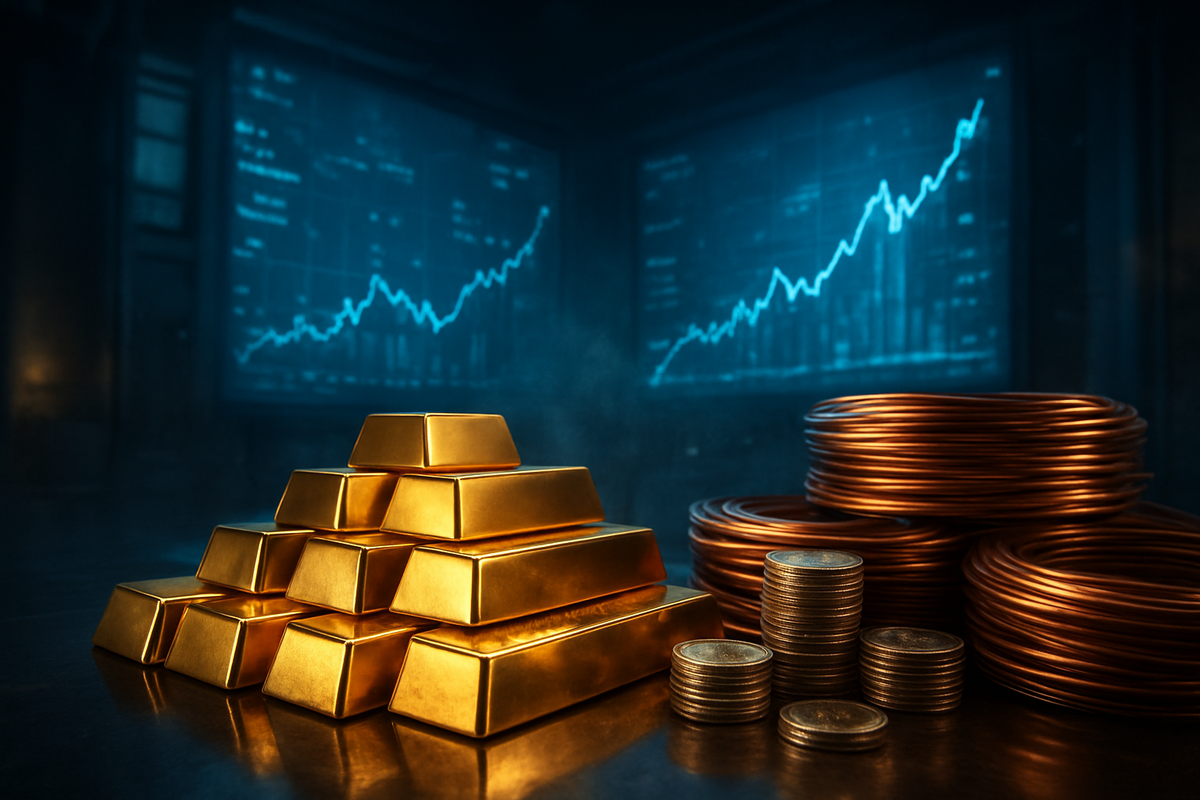
The trajectory of the 2025 metals rally was set in motion during the final quarter of 2024, but few analysts predicted the sheer scale of the ascent. Gold, which broke past the $2,500 mark late last year, has continued its relentless climb, reaching a staggering all-time high of $4,528 per ounce this week. This 70% year-to-date gain has been fueled by a "perfect storm": the Federal Reserve’s aggressive shift toward an accommodative monetary policy—slashing interest rates multiple times throughout 2025—and a massive move by BRICS nations to diversify their reserves away from the U.S. dollar. Central banks have reportedly added over 1,000 tonnes of gold to their coffers this year, providing a relentless floor for prices.
Silver has been the breakout star of the precious metals sector, often referred to by traders as "gold on steroids." Rising from $30 per ounce in early 2024 to a record $72 per ounce in late 2025, silver has benefited from its dual identity as both a monetary safe haven and a critical industrial component. The market is currently grappling with its fifth consecutive year of a structural supply deficit, as the mining industry struggles to keep pace with the massive demand from the solar photovoltaic and automotive sectors.
In the industrial arena, copper has stolen the spotlight, peaking at a historic $12,200 per metric ton this December. The "copper crunch" was exacerbated by a series of supply shocks at major global mines, including technical setbacks at the Grasberg mine in Indonesia and the Kamoa-Kakula project in the DRC. As the electrical backbone of the world, copper’s price action reflects a global scramble for supply as nations race to upgrade aging power grids and build out the massive data centers required to sustain the AI revolution.
The Corporate Landscape: Winners, Losers, and the M&A Frenzy
The primary beneficiaries of this price explosion have been the global mining giants, who have seen their margins expand to historic levels. Newmont (NYSE: NEM), the world’s largest gold producer, has seen its stock price surge over 160% in 2025, as the company successfully divested non-core assets to focus on high-margin, tier-one operations. Similarly, Agnico Eagle (NYSE: AEM) has been a favorite among institutional investors, lauded for its operational focus in low-risk jurisdictions like Canada and Australia, which has shielded it from the rising "resource nationalism" seen elsewhere.
In the base metals sector, BHP Group (NYSE: BHP) and Rio Tinto (NYSE: RIO) have emerged as dominant victors. BHP achieved record copper production in fiscal year 2025, capitalizing on high ore grades at its flagship Escondida mine. Meanwhile, Rio Tinto made waves with its $6.7 billion acquisition of Arcadium Lithium, a strategic move that positions it as a top-tier "energy transition" miner. This acquisition highlights a broader trend: senior producers are no longer content with organic growth and are aggressively using their cash piles to acquire junior miners and secure future supply.
However, the rally has not been without its victims. While mining companies celebrate, downstream manufacturers are feeling the squeeze. Freeport-McMoRan (NYSE: FCX), despite being a major copper producer, faced initial market skepticism after reporting production dips earlier in the year due to lower ore grades, illustrating that even in a bull market, operational execution remains critical. Furthermore, companies in the streaming and royalty space, such as Wheaton Precious Metals (NYSE: WPM), have outperformed traditional miners by capturing the upside of metal prices without the direct exposure to the skyrocketing labor and energy costs currently plaguing the extraction industry.
Wider Significance: AI, Green Energy, and the New Geopolitics
The 2025 surge represents more than just a cyclical boom; it is a structural repricing of the world's most important materials. The most significant shift this year has been the emergence of Artificial Intelligence as a primary driver of metal demand. Data centers, which require high-density power systems and advanced cooling infrastructure, have become massive consumers of copper and silver. Estimates now suggest that AI-related electricity demand will require a total overhaul of global electrical grids, a task that will consume millions of additional tons of copper over the next decade.
This demand is colliding with an increasingly complex geopolitical environment. "Resource nationalism" has moved from a fringe concern to a central theme in 2025, as governments in South America and Africa increasingly view their mineral wealth as a matter of national security. This has led to stricter export controls, higher royalty demands, and a push for domestic processing. The result is a fragmented global supply chain that favors companies with diversified geographic footprints and strong government relations.
The trend also mirrors the "Great Inflation" of the 1970s, but with a modern twist. While the 1970s rally was driven by oil shocks and stagflation, the 2025 rally is being propelled by the "Energy Transition." The irony of the green movement is that it is incredibly mineral-intensive; an electric vehicle requires four times more copper than a traditional internal combustion engine. As 2025 concludes, the market is beginning to realize that the transition to a low-carbon economy may be significantly more expensive—and more metal-dependent—than previously anticipated.
Looking Ahead: What Comes Next for the Metals Market?
As we move into 2026, the primary question for investors is whether these prices are sustainable. In the short term, the market remains in a state of "backwardation," where current prices are higher than future contracts, suggesting that the immediate supply squeeze is far from over. Strategic pivots are already underway; many industrial consumers are exploring "thrifting"—the practice of using less of a specific metal or substituting it with cheaper alternatives—though in the case of copper and silver, viable substitutes remain elusive.
One of the most significant developments to watch in the coming months will be the continued consolidation of the industry. With the "Mega-M&A" cycle in full swing, expect to see more large-cap miners swallowing up mid-tier players to bolster their reserves. Additionally, the adoption of Direct Lithium Extraction (DLE) technologies by companies like Albemarle (NYSE: ALB) could provide a blueprint for how the industry might eventually solve its supply woes through technological innovation rather than just more digging.
Summary and Investor Outlook
The 2025 metals surge has been a masterclass in the power of structural deficits and macroeconomic shifts. Gold and silver have successfully hedged against a weakening dollar and geopolitical strife, while copper has cemented its status as the indispensable metal of the modern era. The key takeaway for the year is that the "commodity super-cycle" is no longer a theoretical projection—it is a present reality.
Moving forward, investors should keep a close eye on central bank rhetoric and the pace of the global energy transition. While the current highs may invite some profit-taking in early 2026, the underlying supply-demand imbalances suggest that the era of "cheap metals" is firmly in the rearview mirror. The lasting impact of 2025 will be the recognition that the digital and green revolutions are built on a foundation of physical materials, and securing those materials is now the world's most urgent economic priority.
This content is intended for informational purposes only and is not financial advice