

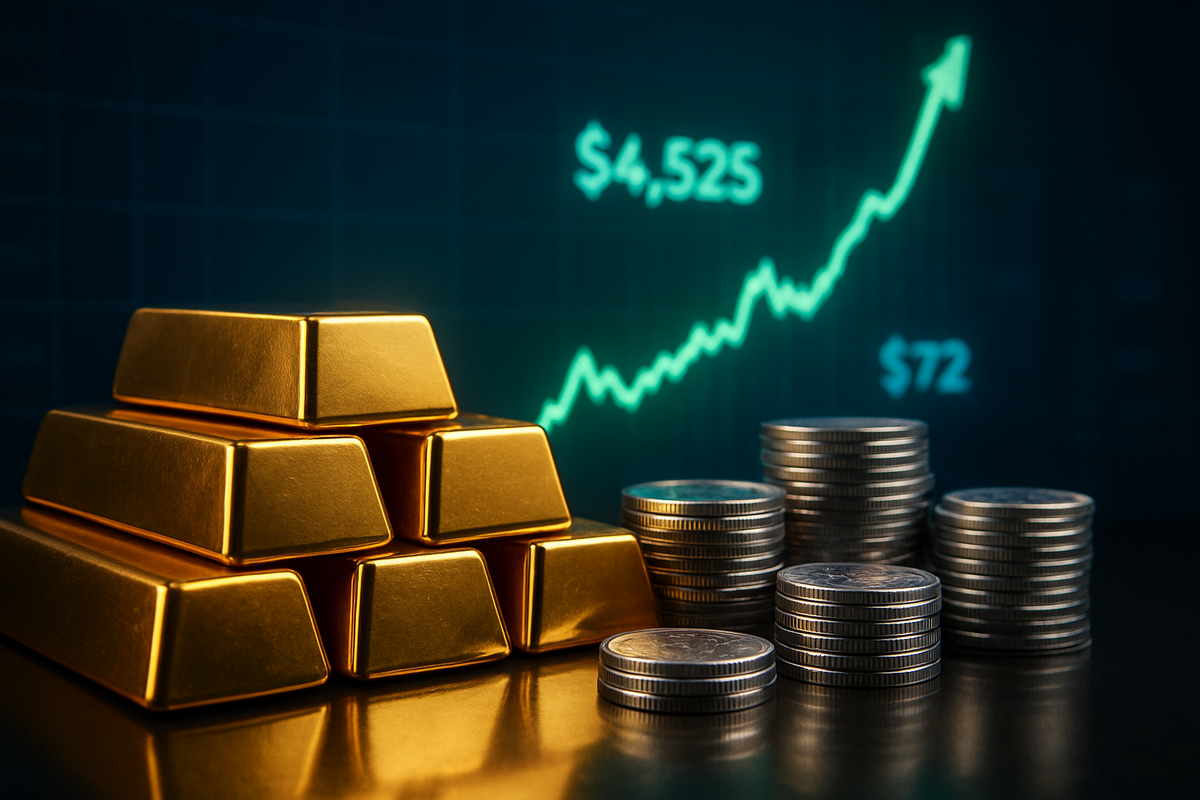
In a historic Christmas Eve surge that has stunned global financial markets, precious metals have vaulted to unprecedented heights, cementing 2025 as the year of the "Hard Asset Super-Cycle." Gold prices reached a staggering $4,525 per ounce in early trading today, while silver breached the $72 mark, marking a monumental shift in the global monetary landscape. This rally, characterized by vertical price action and a total breakdown of traditional resistance levels, represents the most significant wealth migration into tangible assets since the late 1970s.
The immediate implications are profound: a massive revaluation of global reserves is underway as the U.S. dollar faces its steepest annual decline in a decade. Investors are fleeing sovereign debt and fiat currencies in favor of the "ultimate insurance policy," driven by a combination of aggressive central bank accumulation and a geopolitical landscape that has become increasingly fractured. As the market heads into the final week of the year, the breach of these psychological barriers suggests that the era of low-cost precious metals is officially a thing of the past.
A Historic Breakout: The Road to $4,500 and Beyond
The journey to $4,525 for gold and $72 for silver was paved by a series of escalating macroeconomic triggers throughout 2025. The rally intensified in the fourth quarter as the Federal Reserve delivered its third consecutive interest rate cut, signaling a definitive pivot toward growth over inflation control. This monetary easing, coupled with a 10% slump in the U.S. Dollar Index, created a vacuum that only precious metals could fill. Technical analysts have been pointing to a "Triple Cup and Handle" formation on gold’s long-term charts for months, a pattern that finally resolved to the upside in November, catapulting the metal from its $3,800 base to today’s record highs.
Silver’s ascent has been even more dramatic, completing what many are calling a "45-year breakout." Since the Hunt Brothers' era in 1980, silver has struggled to maintain momentum above $50. However, a structural supply deficit—now in its fifth consecutive year—combined with surging demand for silver in AI infrastructure and high-efficiency solar cells, forced a short squeeze of epic proportions. When the $50 resistance finally crumbled in mid-November, silver entered a "price discovery" phase, moving almost vertically to the $72 level reported this morning.
Key stakeholders in this rally include the world’s central banks, which have transitioned from cyclical buyers to structural accumulators. Led by the People’s Bank of China and the Reserve Bank of India, these institutions have purchased over 850 tonnes of gold in 2025 alone. The geopolitical catalyst that pushed prices over the final edge was the escalating crisis in South America, where a U.S. naval blockade of Venezuelan oil tankers sparked fears of a broader regional conflict, sending safe-haven demand into overdrive just as the holiday season began.
Mining Titans and Industrial Victims: The Winners and Losers
The primary beneficiaries of this price explosion are the major mining corporations, which are currently generating record-breaking free cash flow. Newmont (NYSE: NEM), the world’s largest gold producer, has seen its stock hit all-time highs near $102, with analysts projecting an annual free cash flow of $4.5 billion. Similarly, Barrick Gold (NYSE: GOLD) has leveraged its low-cost operations in Nevada to drive a $1.5 billion share buyback program, rewarding investors who stayed the course during the leaner years of the early 2020s.
In the silver space, Pan American Silver (NASDAQ: PAAS) has emerged as a standout performer, with its shares surging nearly 90% in 2025 following the successful ramp-up of its high-grade Juanicipio operations. Perhaps the biggest winner, however, is Wheaton Precious Metals (NYSE: WPM). As a streaming company, Wheaton’s fixed-cost model allows it to purchase silver at prices as low as $6.00 per ounce, meaning the jump to $72 represents almost pure profit. Their stock reached a record $122.81 this week, maintaining a staggering 84% gross profit margin that is the envy of the resource sector.
Conversely, the rally has placed immense pressure on industries that rely on silver as a critical industrial input. Solar panel manufacturers like First Solar (NASDAQ: FSLR) are facing surging raw material costs that could threaten the thin margins of the renewable energy transition. Similarly, electronics giants and electric vehicle manufacturers are beginning to voice concerns over "silver-flation," which may necessitate a strategic shift toward thrifting or substituting the metal in future component designs if prices remain above the $70 threshold.
De-Dollarization and the New Monetary Paradigm
The significance of gold at $4,500 and silver at $70 extends far beyond mere price points; it signals a fundamental shift in the global financial order. We are witnessing the "de-dollarization" trend move from theory to reality. The repatriation of physical gold—most notably India’s recent move to bring 100 tonnes of its reserves home from the United Kingdom—underscores a growing distrust in the "paper" financial system and a preference for physical custody in a volatile world.
Historically, this rally draws parallels to the 1979-1980 period, yet the drivers today are more structurally entrenched. Unlike the 1980 peak, which was broken by Paul Volcker’s aggressive interest rate hikes, the 2025 Fed is grappling with a massive national debt that makes high-interest rates unsustainable. This has created a "debt-trap" scenario where inflation is tolerated to devalue the debt, a perfect environment for precious metals. Furthermore, the integration of silver into the "Fourth Industrial Revolution"—specifically AI and green energy—means its price is no longer purely speculative but is driven by essential industrial necessity.
The ripple effects are reaching the bond markets as well. The traditional 60/40 portfolio is being questioned as sovereign bonds fail to provide the same hedging benefits they once did. In response, institutional investors and pension funds are increasingly allocating 5% to 10% of their portfolios to physical gold and silver, a move that provides a continuous floor of demand that was absent in previous decades.
The Road Ahead: Consolidation or Continued Ascent?
As we look toward 2026, the immediate question is whether these levels are sustainable. In the short term, a period of consolidation is likely. After such a parabolic move, profit-taking during the January "tax-loss selling" reversal could see gold test support at the $4,200 level and silver pull back toward $65. However, technical analysts argue that these "pullbacks" will be viewed as major buying opportunities for those who missed the initial breakout.
The long-term outlook remains bullish. Many major investment banks are already revising their 2026 targets, with some suggesting gold could reach $5,000 if geopolitical tensions in Eastern Europe and the Middle East remain unresolved. For silver, the supply-demand imbalance shows no signs of easing, as mining supply remains stagnant due to a decade of underinvestment in exploration. Companies will need to pivot toward more aggressive exploration and M&A activity to replace reserves, likely leading to a new wave of consolidation in the junior mining sector.
Investors should also watch for potential regulatory responses. If silver prices continue to climb, we may see the implementation of "strategic metal" designations by Western governments, potentially leading to export restrictions or government-mandated stockpiling to protect domestic green-energy industries.
Final Thoughts for the 2026 Investor
The breach of $4,525 gold and $72 silver is a watershed moment that validates the "hard asset" thesis. For the average investor, the key takeaway is that precious metals have transitioned from speculative trades to essential components of wealth preservation in an era of fiscal dominance and geopolitical instability. The "Hard Asset Super-Cycle" is no longer a forecast; it is the current reality of the 2025 market.
Moving forward, market participants should keep a close eye on central bank gold reserve reports and the U.S. Treasury's ability to manage its debt auctions. Any sign of a "failed auction" or a further breakdown in the dollar's purchasing power will likely act as a catalyst for the next leg up in this historic rally. While the volatility may be gut-wrenching, the underlying fundamentals suggest that the golden era is just beginning.
This content is intended for informational purposes only and is not financial advice.