

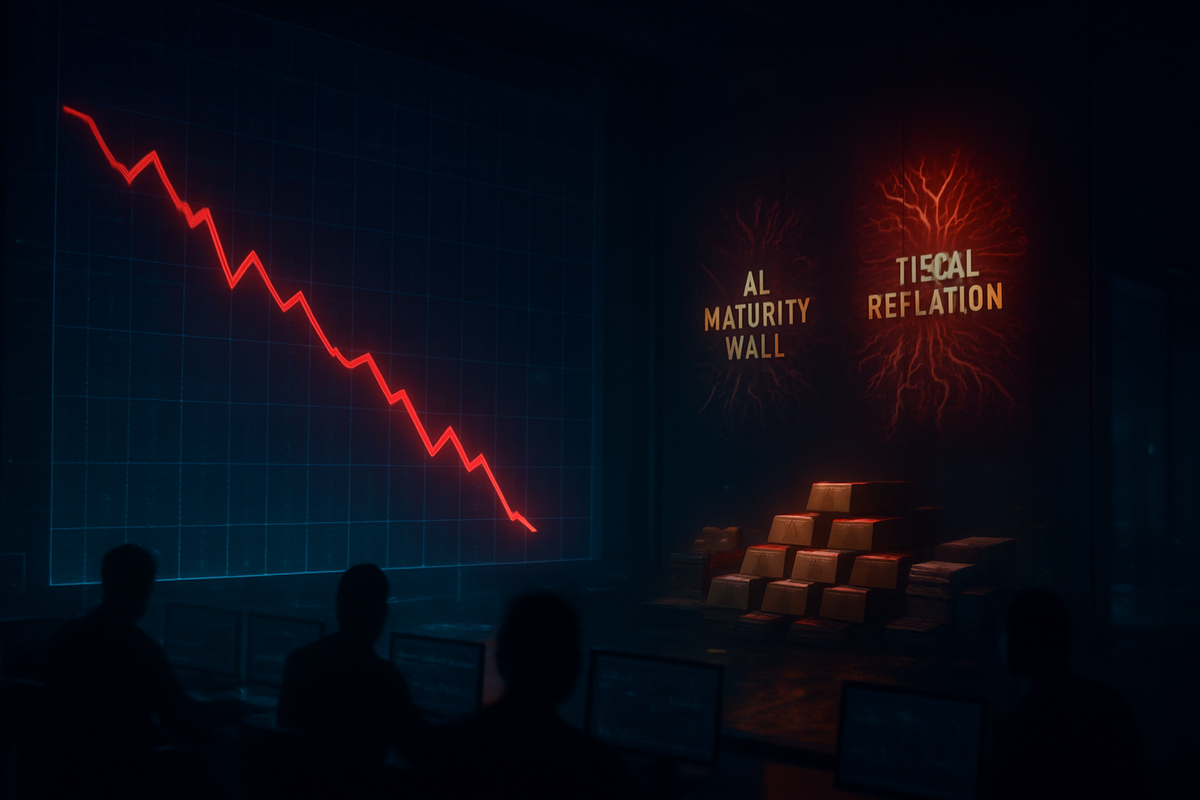
As 2025 draws to a close, a sobering forecast from Barron’s has sent ripples through the financial community, suggesting a 10% probability of a massive 30% stock market crash in 2026. While the broader consensus remains cautiously optimistic for the new year, this "tail risk" scenario highlights a precarious intersection of fiscal overheating, geopolitical instability, and a potential reckoning for the artificial intelligence boom.
The report, published in late 2025, serves as a stark reminder that the record-breaking highs of the past year may have been built on a fragile foundation. For investors who have grown accustomed to the relentless climb of the S&P 500, the prospect of a drawdown of this magnitude—which would effectively erase two years of gains—demands a closer look at the structural vulnerabilities currently hiding in plain sight.
The Catalysts of a Potential Collapse
The Barron’s report identifies four primary "tripwires" that could trigger a 30% decline. At the forefront is the risk of "Fiscal Reflation." Following the massive tax cuts and business incentives enacted in mid-2025, the U.S. economy has shown signs of overheating. Analysts at JPMorgan Chase & Co. (NYSE: JPM) warn that this $90 billion injection could push inflation back toward the 4% mark, forcing the Federal Reserve to abandon its planned rate cuts and potentially return to a tightening cycle in 2026.
Beyond domestic policy, the "AI Maturity Wall" looms large. For the past two years, the market has been driven by the promise of generative AI, but the report suggests that 2026 will be the year of the "clash of magnitudes." Investors are beginning to question the return on investment (ROI) for the hundreds of billions spent on infrastructure. If major cloud providers fail to show significant revenue growth from these investments, a sharp revaluation of the tech sector is likely. Furthermore, a "Corporate Maturity Wall" is approaching; many firms that secured low-interest debt during the 2020-2021 period will be forced to refinance at significantly higher rates in 2026, which Allianz SE (OTC:ALIZY) predicts could lead to a 5-6% spike in commercial bankruptcies.
Geopolitical tensions add a final layer of volatility. The report highlights potential supply shocks originating from renewed sanctions on Venezuelan oil and escalating friction in the South China Sea. These events are described as "liquidity omnivores"—crises that cause investors to flee all asset classes simultaneously, including gold and stocks, in a desperate rush for cash.
Winners and Losers in a High-Volatility Regime
If the 10% probability event manifests, the impact will be felt most acutely by the "hyperscalers" and high-multiple growth stocks. Microsoft Corp. (NASDAQ: MSFT) and Alphabet Inc. (NASDAQ: GOOGL), which have led the market higher on AI optimism, could face significant downward pressure if their capital expenditures continue to outpace earnings growth. Similarly, NVIDIA Corp. (NASDAQ: NVDA) remains highly sensitive to any shift in the AI narrative or disruptions in the global semiconductor supply chain centered in Taiwan.
Conversely, defensive sectors and "tail-risk" beneficiaries could emerge as relative winners. BlackRock, Inc. (NYSE: BLK) has suggested that 2026 will not be a year for passive indexing, but rather for active management and private credit. Companies in the healthcare and consumer staples sectors, such as Johnson & Johnson (NYSE: JNJ) and The Procter & Gamble Company (NYSE: PG), are expected to provide a buffer against volatility. Additionally, firms specializing in cybersecurity and defense, like Lockheed Martin Corp. (NYSE: LMT), may see increased demand as geopolitical risks materialize, providing a hedge for diversified portfolios.
Financial institutions like Goldman Sachs Group, Inc. (NYSE: GS) and Morgan Stanley (NYSE: MS) face a more complex outlook. While a market crash would hurt their asset management and investment banking divisions, a return to higher interest rates and increased trading volatility could bolster their fixed-income and commodities trading desks. However, the "concentration risk" of the current market means that even these giants are not immune to a systemic deleveraging event.
The Wider Significance: A Liquidity Vacuum
The potential 2026 crash is not viewed as a standard cyclical downturn but rather as a "Liquidity Vacuum," reminiscent of the sudden deleveraging seen during the 2020 COVID-19 crash. This event would fit into a broader trend of "fragile prosperity," where market indices are driven by a handful of mega-cap stocks while the underlying economy shows signs of a "K-shaped" divergence. David Kelly of J.P. Morgan has noted that while the top 10% of households are thriving, the remaining 90% are increasingly squeezed by "sticky" inflation, creating a social and economic fragility that could snap under pressure.
Historically, periods of high fiscal spending combined with tight monetary policy have rarely ended in a "soft landing." The 2026 forecast echoes the late 1960s, where aggressive government spending eventually led to a lost decade for stocks. Furthermore, the regulatory environment is shifting; increased scrutiny on AI monopolies and data privacy could act as a secondary drag on the tech sector, making it harder for these companies to "grow" their way out of a valuation crisis.
Strategic Pivots and the Road Ahead
As we move into 2026, the primary challenge for investors will be navigating the "choppy, late-cycle" regime described by Lisa Shalett of Morgan Stanley. Short-term, the market may remain buoyant on the fumes of 2025’s momentum, but the "animalistic" retail behavior and high levels of leverage currently in the system suggest that any correction will be swift and deep. Strategic pivots toward value-oriented sectors, international diversification, and increased cash allocations are already being discussed in the halls of major wealth management firms.
The long-term outcome of a 30% crash, while painful, could serve as a necessary "cleansing" of the market. It would force a more disciplined allocation of capital toward AI projects with proven utility and reset valuations to more sustainable levels. Market opportunities may emerge in distressed debt and "beaten-down" small-cap stocks that have been ignored during the mega-cap frenzy of the mid-2020s.
Navigating an Uncertain 2026
The Barron's report serves as a crucial warning: the 10% chance of a 30% crash is high enough that it cannot be ignored. The convergence of a "Fiscal Cliff," an "AI Reality Check," and geopolitical instability creates a cocktail of risk that could redefine the investment landscape for years to come. The key takeaway for investors is the end of the era of "easy gains" through passive indexation.
Moving forward, the market will likely be defined by extreme dispersion—where the gap between winners and losers widers significantly. Investors should watch for signs of a "liquidity drain," such as rising bond yields alongside falling stock prices, and keep a close eye on quarterly earnings from the "Magnificent Seven" for any signs of AI fatigue. While a crash is not the guaranteed outcome, the margin for error in 2026 has never been thinner.
This content is intended for informational purposes only and is not financial advice