

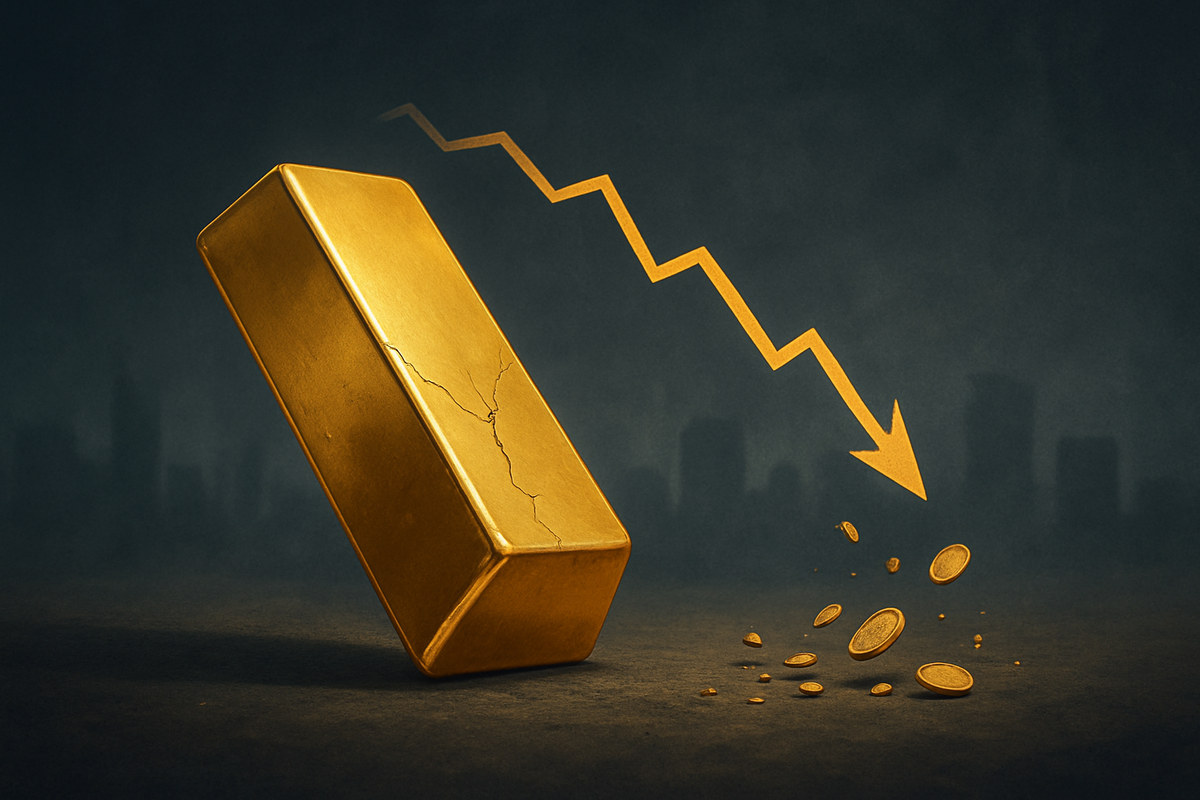
New Delhi, India – December 16, 2025 – The golden run in the Indian market has hit a significant snag, as gold prices experienced a sharp retreat today, snapping a remarkable record rally that had captivated investors. The precious metal, after soaring to unprecedented highs, witnessed a notable slip of approximately ₹1,700 per 10 grams in the national capital, signaling a potential shift in market sentiment.
This immediate downturn comes on the heels of a robust four-day record rally in India and a five-day winning streak in international spot gold markets, which had culminated just yesterday. The sudden reversal has prompted market participants to re-evaluate their positions, with profit-booking, weak global cues, and anticipation of crucial US economic data and Federal Reserve policy decisions being cited as immediate catalysts for the decline.
The Golden Correction: Unpacking the Retreat
The retreat on December 16, 2025, saw gold of 99.9% purity decline to ₹1,35,900 per 10 grams, a day after surging to an all-time high of ₹1,37,600 per 10 grams. This significant price adjustment was mirrored across various gold categories, with 24 Karat gold falling by ₹152 per gram (₹15,200 per 100 grams) to ₹13,386 per gram, and 22 Karat gold trading lower by ₹140 per gram (₹14,000 per 100 grams) at ₹12,270 per gram. On the Multi Commodity Exchange (MCX), gold February futures also slipped by ₹456, or 0.34%, to ₹1,33,674 per 10 grams, retreating from its all-time high of ₹1,35,496.
This downturn was influenced by several immediate factors. Investors engaged in widespread profit-taking after the substantial gains observed during the preceding record rally. Globally, spot gold snapped its five-day winning streak, falling by $27.80 (0.65%) to $4,277.42 per ounce, reflecting weak international cues. Furthermore, market participants adopted a cautious stance ahead of critical US economic data releases and decisions from central banks like the Bank of Japan, which are expected to provide further clarity on the future trajectory of interest rates. While earlier Federal Reserve rate cuts in late 2024 and early December 2025 had fueled the rally, a cautious tone regarding further rate cuts or repositioning ahead of new data contributed to the downturn. Technical analysis also suggested that gold was in "overbought" territory, indicating that prices were stretched and a corrective pullback was likely.
The impact of the domestic price fall in India was partly offset by the persistent weakness of the Indian Rupee, which was trading at a record low. However, subdued physical jewelry demand, attributed to the onset of an inauspicious period, also played a role. Despite this recent retreat, some analysts view this dip as a "minor pullback within a much larger bullish setup" and a "tactical entry point rather than a signal of a new downward trend," especially given expectations of potential central bank actions in early 2026, including anticipated US Federal Reserve interest rate cuts. The broader outlook for gold in 2026 remains bullish for many, supported by easing monetary policy, fiscal concerns, geopolitical risks, and continued central bank demand.
Key players and stakeholders involved in these market movements include central banks, particularly the U.S. Federal Reserve and the Bank of Japan, whose monetary policy decisions heavily influence global interest rates and currency valuations. Large institutional investors, hedge funds, and retail investors who engaged in the recent rally are also significant players, with their collective profit-taking contributing to the current retreat. Major gold producers like Barrick Gold (NYSE: GOLD) and Newmont (NYSE: NEM), along with gold-backed exchange-traded funds (ETFs) such as SPDR Gold Shares (NYSEARCA: GLD), are also directly impacted by these price fluctuations.
Corporate Fortunes: Who Wins and Who Loses?
A significant retreat in gold prices sends ripples across various public companies, creating both "losers" and "potential winners" depending on their direct exposure and business models.
Potential Losers: Companies whose primary business revolves around the production or direct holding of gold would likely experience a negative impact. Gold mining companies are most directly affected, as their revenues are inherently tied to the per-ounce price of the gold they extract. A decline directly leads to lower revenue per ounce sold, contracting profit margins and potentially leading to reduced exploration, delayed new projects, or even mine closures. Major players like Barrick Gold (NYSE: GOLD), Newmont (NYSE: NEM), Kinross Gold (NYSE: KGC), and Agnico Eagle Mines (NYSE: AEM) would face reduced earnings and cash flow, impacting their stock valuations. Similarly, gold royalty and streaming companies like Franco-Nevada (FNV), whose revenues are tied to production volume and market price, would see diminished income streams. Investment funds with direct gold holdings, such such as SPDR Gold Shares (NYSEARCA: GLD), would see their assets under management (AUM) and consequently their fee income decrease, leading to a fall in their share price.
Potential Winners: While less common, some companies could potentially benefit from lower gold prices. Jewelry retailers, for instance, could see reduced costs for their primary raw material. If they maintain selling prices or only partially pass on savings, lower gold acquisition costs would lead to higher profit margins. Moreover, a significant retreat could make gold jewelry more affordable, potentially stimulating consumer demand that may have been suppressed during periods of high prices. Companies like PC Jeweller (NSE: PCJEWELLER) and Rajnish Retail could potentially benefit from improved margins or increased sales volume, assuming effective inventory management. Similarly, companies in industries using gold as a raw material, such as electronics manufacturers, could see a reduction in their cost of goods sold, improving gross profit margins.
Mixed or Indirect Impact: Gold loan companies, which provide loans against gold collateral, typically maintain conservative loan-to-value (LTV) ratios. Therefore, a price fall often has "no impact" on their existing loan portfolios, as stated by the Association of Gold Loan Companies (AGLOC). However, investor perception of risk could increase, potentially causing some short-term stock volatility for companies like Muthoot Finance or Manappuram Finance.
Wider Significance: A Barometer of Market Shifts
The gold price retreat on December 16, 2025, carries considerable wider significance, acting as a barometer for broader shifts in financial markets and the global economy.
This event likely signals a shift in investor sentiment not just for gold, but for the entire precious metals complex. Gold often acts as a bellwether, and a sharp decline could trigger corresponding drops in silver, platinum, and palladium due to shared market drivers like global economic outlook, the strength of the U.S. dollar, and safe-haven demand. For gold mining companies, this translates to immediate pressure on profitability, potentially leading to reduced exploration, asset impairment, or even mergers and acquisitions among stronger players seeking distressed assets. The retreat also suggests a decrease in safe-haven demand, indicating investors may be rotating into perceived higher-yielding or growth assets like equities or bonds, often seen during periods of economic optimism or rising real interest rates.
The ripple effects extend beyond precious metals. If the gold retreat is driven by a broader "risk-on" sentiment or a stronger U.S. dollar, other traditional safe-haven assets like government bonds might also see decreased demand. Central banks, significant holders of gold reserves for long-term stability and diversification, would see the nominal value of these reserves decrease, though their long-term strategy remains largely unchanged. Developing economies that are major gold producers or exporters could face economic impacts through reduced export revenues.
From a regulatory and policy perspective, a gold retreat linked to expectations of higher interest rates or reduced inflation could validate a tightening monetary policy stance by central banks. Extreme volatility could also prompt regulators to monitor market stability more closely, especially concerning gold-backed investment products. Historically, similar retreats have occurred. The 1980s post-peak decline and the 2013 "Taper Tantrum" and subsequent decline were both driven by factors like falling inflation, rising real interest rates, and a strengthening U.S. dollar, reducing gold's appeal. A 2025 retreat, if driven by strong economic growth, higher real interest rates from tighter monetary policies, a strong U.S. dollar, or reduced inflation expectations, would align with these historical patterns.
The Road Ahead: Navigating the Golden Path
The gold market, having experienced a significant retreat, faces a complex outlook shaped by various short-term and long-term possibilities. While the dip to $4,294.17 per troy ounce on December 16, 2025, is notable, the broader market dynamics and investor sentiment will dictate its future trajectory.
In the short term, increased volatility is likely as investors engage in profit-taking. Gold prices will remain highly sensitive to upcoming economic indicators, with strong data potentially reducing safe-haven demand, and weaker data reigniting it. A stronger US dollar and rising real yields, driven by hawkish central bank stances, could continue to dampen demand for non-yielding gold. Conversely, any easing of geopolitical tensions could further reduce the immediate need for safe-haven assets. For market participants, strategic pivots are crucial. Investors might consider rebalancing portfolios, utilizing dollar-cost averaging during dips, and diversifying beyond just gold. Gold mining companies will prioritize cost management, operational efficiency, and hedging strategies. Central banks are expected to continue their strategic accumulation for diversification and geopolitical hedging.
Looking long-term, gold's fundamental role as a hedge against economic uncertainty, inflation, and geopolitical risks remains strong. Persistent high inflation or its anticipation tends to bolster gold prices. The consistent accumulation by central banks globally, driven by diversification away from the US dollar and geopolitical hedging, provides a significant structural support. Ongoing global political instability will also likely sustain safe-haven demand. Potential scenarios include a quick recovery and continued bull run driven by renewed inflation concerns and dovish monetary policy, a prolonged consolidation phase characterized by profit-taking and strong performance in other asset classes, or, less likely, further declines if aggressive interest rate hikes and sustained US dollar strength materialize. Emerging markets will continue to play a vital role, with robust consumer demand and central bank buying offering opportunities, while currency impacts and domestic policies pose challenges.
Golden Horizon: A Strategic Outlook
The gold market's recent retreat on December 16, 2025, serves as a sharp reminder of the precious metal's dynamic nature and its responsiveness to the intricate interplay of global economic forces. While the snap of a record rally and the ₹1,700 per 10 gram price slip might cause immediate concern, it is essential to view this event within the broader context of gold's long-term drivers and historical patterns.
Key Takeaways: The retreat was primarily driven by profit-taking after an extraordinary rally, coupled with a strengthening US dollar, rising bond yields (fueled by expectations of tighter monetary policy), and an improvement in overall economic confidence. Weakened physical demand, partly due to seasonal factors, also contributed to the downward pressure. This combination of factors suggests a temporary shift in investor preference away from safe-haven assets towards potentially higher-yielding alternatives.
Assessing the Market Moving Forward: While the immediate future may see continued volatility and a testing of new support levels, many experts maintain a generally bullish long-term outlook for gold. Forecasts still anticipate average prices climbing towards $4,000/oz by mid-2026 and potentially reaching $5,000/oz by 2030. The market will be closely watching for signals from central banks, particularly the US Federal Reserve, regarding interest rate policies and inflation management. The persistent weakness of the Indian Rupee, for instance, could partially offset domestic price drops, highlighting the complex interplay of international and local factors.
Final Thoughts on Significance and Lasting Impact: This correction, though sharp, could be a healthy recalibration in a market that had seen substantial gains. It underscores that even safe-haven assets are not immune to market forces. The lasting impact will depend on whether the current drivers represent a fundamental shift in the global economic landscape or a temporary rebalancing. If inflation remains sticky and geopolitical risks persist, gold's appeal as a hedge and store of value could quickly reassert itself. Conversely, a sustained period of robust global growth and normalized interest rates could temper its momentum. Crucially, the continued strategic purchases by central banks, driven by diversification and geopolitical concerns, will remain a structural support for gold in the long run.
What Investors Should Watch For in Coming Months: Investors should adopt a cautious yet strategic approach. Closely monitor macroeconomic indicators such as inflation data, central bank monetary policy announcements, and unemployment figures. The strength of the US dollar remains a pivotal factor, as does the evolution of geopolitical developments. For long-term investors, dollar-cost averaging during dips can be a sound strategy. Diversification within portfolios, including various forms of gold exposure (physical bullion, ETFs, mining stocks), is also advisable. Understanding that gold prices can be volatile, and rapid swings can present both risks and opportunities, will be key to navigating the market successfully in the coming months.
This content is intended for informational purposes only and is not financial advice