

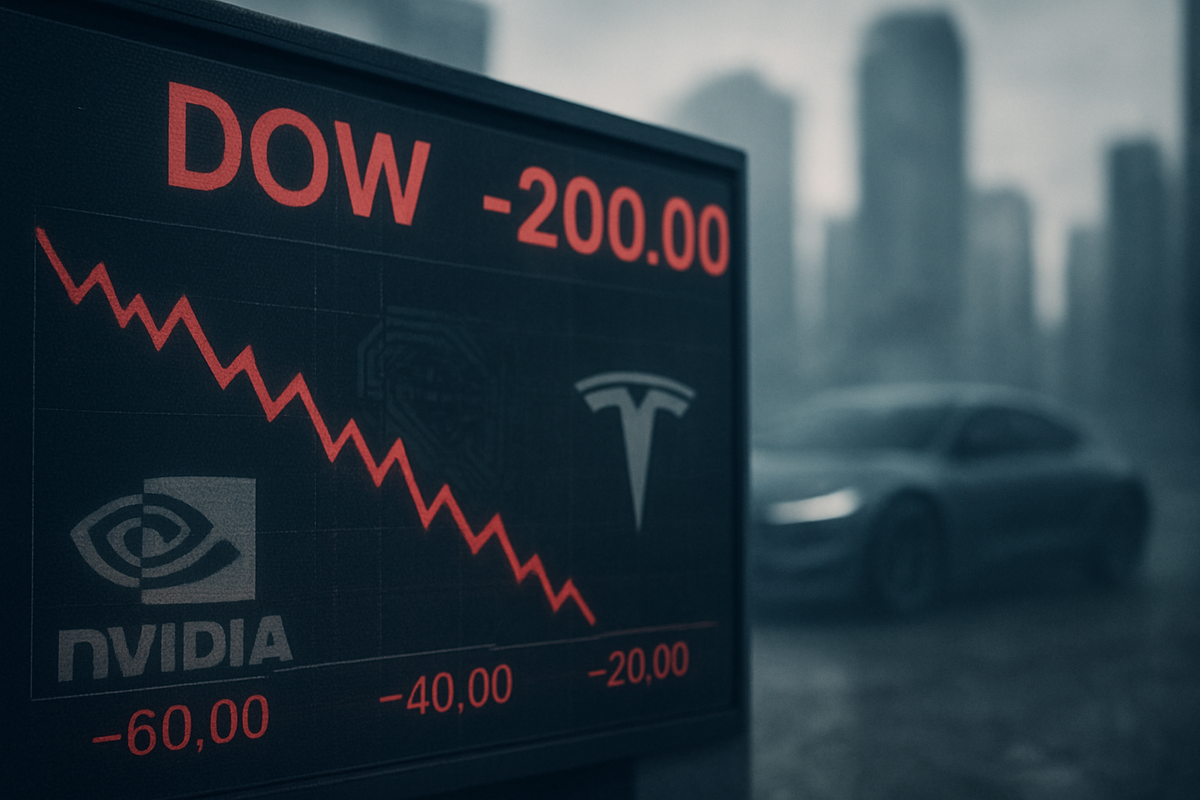
New York, NY – December 1, 2025 – The Dow Jones Industrial Average (DJIA) experienced a notable 200-point decline today, signaling a cautious end to the year for investors. This market movement is largely attributable to a confluence of factors: persistently weak consumer sentiment, growing apprehension regarding tech stock valuations, and ongoing uncertainty surrounding the Federal Reserve's interest rate policy. The drop reflects a broader market re-evaluation of risk and growth prospects as the economic landscape continues to evolve, with high-profile technology leaders like Nvidia (NASDAQ: NVDA) and Tesla (NASDAQ: TSLA) feeling the brunt of the selling pressure.
This moderate downturn, while not signaling an immediate crisis, underscores a fragile economic landscape where investor confidence is easily swayed by consumer health indicators and the performance of high-growth sectors. The market's reaction suggests that investors are increasingly factoring in macroeconomic risks beyond quarterly earnings, setting a cautious tone for the coming months.
Underlying Currents Dragging Down the Market
Today's 200-point slide in the Dow Jones Industrial Average is not an isolated event but rather a symptom of deeper, interconnected economic concerns that have been brewing in recent weeks. A primary driver appears to be the stubbornly weak consumer sentiment, fueled by persistent inflation, high prices, and anxieties about weakening incomes and the labor market. Reports indicate that U.S. consumer confidence has reached its lowest levels in months, leading to a cautious approach to holiday spending, despite some strong online sales figures.
Compounding this consumer malaise are lingering questions surrounding the Federal Reserve's monetary policy. While expectations for interest rate cuts in late 2025 and into 2026 persist, the exact timing and magnitude remain ambiguous. This "higher for longer" interest rate environment, coupled with above-trend economic growth and sticky inflation, poses an impediment to both economic growth and risk asset returns. Higher borrowing costs for businesses and consumers directly impact corporate profits and overall market volatility. Furthermore, growing concerns about overvaluation in the technology sector, particularly among AI-driven stocks, have contributed to a re-examination of market multiples.
Initial market reactions saw a broad defensive posture. While the Dow experienced a significant drop, other major indices like the S&P 500 and Nasdaq Composite also registered declines, reflecting a systemic shift in investor sentiment. This widespread selling pressure, particularly in growth-oriented sectors, indicates a move away from speculative investments towards more stable assets. Key players in this scenario include the Federal Reserve, whose future policy decisions are keenly awaited, and major corporations whose earnings and forward guidance will continue to shape investor outlook.
Tech Giants Feel the Pinch: Nvidia and Tesla Slide
The market's shift towards caution has had a pronounced impact on high-growth technology companies, with Nvidia (NASDAQ: NVDA) and Tesla (NASDAQ: TSLA) experiencing notable slides. These companies, often valued on the promise of substantial future growth and innovation, are particularly sensitive to the very factors currently weighing on the market: interest rates and valuation scrutiny.
Nvidia, a dominant force in the artificial intelligence (AI) chip market, has been a significant market leader, but its elevated valuation has drawn increasing scrutiny. Concerns about an "AI bubble" have been voiced by industry leaders, and analysts are questioning whether the current price-to-earnings ratios can be sustained if AI adoption or corporate profitability falls short of lofty expectations. Higher interest rates diminish the present value of Nvidia's anticipated future earnings, making its stock less attractive to investors seeking more immediate returns or lower-risk opportunities.
Similarly, Tesla (NASDAQ: TSLA), a pioneer in electric vehicles and renewable energy, is susceptible to weak consumer sentiment. As consumers tighten their belts amid inflation and economic uncertainty, demand for big-ticket discretionary items like new cars can soften. Tesla's valuation, like many growth stocks, is heavily reliant on future sales and expansion, and any perceived slowdown in consumer spending or increased competition in the EV market can trigger significant sell-offs. Both companies, despite their strong underlying businesses and innovative products, are caught in a broader market recalibration where risk aversion is gaining traction.
Broader Implications and Historical Context
The 200-point Dow drop, while not a catastrophic percentage decline, carries significant wider implications, especially when viewed against the backdrop of prevailing economic concerns in late 2025. It serves as a critical signal of underlying economic fragility and heightened investor caution, underscoring the interconnectedness of economic data, corporate earnings, and overall market stability.
This event fits into broader industry trends characterized by a potential shift in capital flows. During periods of market uncertainty, investors often rotate out of highly valued sectors, such as mega-cap technology, into areas offering better risk-adjusted returns, including defensive sectors or value stocks. This could empower smaller, innovative companies in other sectors while challenging the market share of established giants. Ripple effects could see reduced consumer spending impacting a wide array of sectors from retail to travel, and credit market contractions potentially stifling growth for smaller firms.
Historically, market corrections are common, with the S&P 500 experiencing numerous declines of 10-20% from recent highs. Not all corrections escalate into full-blown bear markets, but they are more likely to do so when associated with a recession. This current downturn, influenced by inflation, interest rate uncertainty, and consumer sentiment, echoes elements of past periods where economic slowdowns and valuation concerns led to significant market adjustments. Regulatory or policy implications could arise if the downturn deepens, potentially prompting central banks to adjust monetary policy, or governments to consider fiscal interventions to stabilize the economy, drawing lessons from events like the 2008 financial crisis which led to the Dodd-Frank Act.
Navigating the Path Ahead
The coming months are poised to be a period of continued vigilance and strategic adaptation for both companies and investors. In the short term, increased market volatility is expected as participants react to incoming economic data and any clearer signals from central banks regarding interest rate policy. Sector rotation is likely to persist, with capital potentially flowing into defensive assets and sectors while high-growth tech continues to face scrutiny. A sustained slowdown in consumer spending could pose a significant headwind for many businesses.
Long-term possibilities, however, often point to market recovery. Historical patterns suggest that markets tend to rebound from downturns, rewarding disciplined, long-term investors. The underlying innovation in technology, particularly AI, remains a powerful long-term growth driver, though the winners might shift from pure builders of technology to its beneficiaries. If interest rate uncertainty subsides, it could ease market volatility and create opportunities in rate-sensitive sectors.
Companies will need to prioritize cash flow management, optimize costs, and strengthen financial resilience. Diversifying revenue streams and focusing on core customer loyalty will be critical. For investors, this period presents both challenges and opportunities. While heightened risk aversion and the difficulty of timing the market are significant hurdles, downturns can offer buying opportunities for long-term investors through strategies like dollar-cost averaging. Diversification, a focus on strong fundamentals, and rebalancing portfolios will be key to navigating this evolving landscape.
A Cautious Outlook Demands Vigilance
Today's 200-point decline in the Dow Jones Industrial Average serves as a crucial reminder of the market's sensitivity to macroeconomic fundamentals. The confluence of weak consumer sentiment, concerns over tech valuations, and the lingering uncertainty surrounding interest rate policy has created an environment of caution. This is not merely a transient blip but a reflection of deeper economic currents that demand attention.
Moving forward, the market is likely to remain volatile, characterized by periods of apprehension and potential for further adjustments, particularly in high-flying growth sectors. The lasting impact could be a shift towards a more discerning investment landscape where fundamental strength and sustainable growth are prioritized over speculative narratives. If consumer confidence continues its erosion, it could signal a broader economic slowdown, potentially leading to lower corporate earnings and further market instability.
Investors in the coming months should prioritize monitoring key economic indicators, including consumer confidence, inflation reports, and labor market data. Close attention to Federal Reserve announcements will be paramount for insights into interest rate trajectory. Furthermore, a critical re-evaluation of tech holdings, a steadfast commitment to diversification, and robust risk management strategies will be essential. The market's current posture demands an informed, agile, and long-term perspective to successfully navigate the evolving financial terrain.
This content is intended for informational purposes only and is not financial advice