
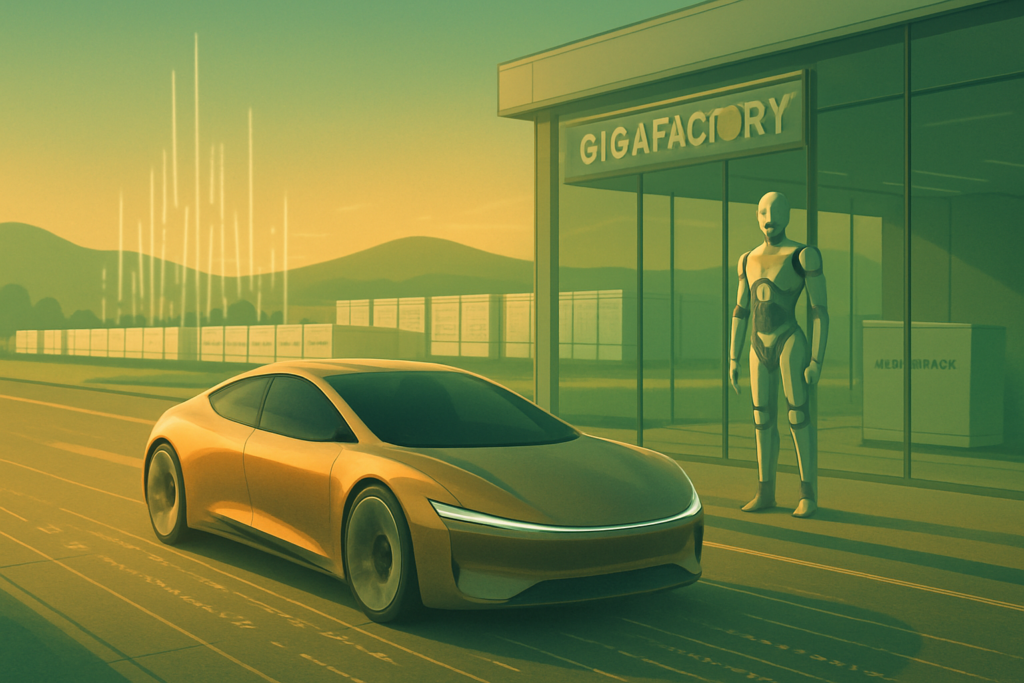
As of March 5, 2026, Tesla, Inc. (NASDAQ: TSLA) finds itself at a historic inflection point. Long celebrated as the undisputed leader of the electric vehicle (EV) revolution, the company has spent the last 24 months navigating a "identity transition" that has polarized Wall Street. While the automotive industry globally is grappling with a cooling of consumer EV demand—often referred to as the "EV Winter" of 2024-2025—Tesla is attempting to shed its skin as a car manufacturer to emerge as a dominant force in physical AI, robotics, and energy infrastructure.
The current narrative is no longer just about delivery targets for the Model 3 or Model Y. Instead, the focus has shifted to the impending volume production of the Cybercab, the operational integration of the Optimus humanoid robot, and a surging energy storage business that is beginning to rival the automotive segment in terms of margin profile. With its stock trading at a forward price-to-earnings (P/E) ratio exceeding 300x, Tesla is being valued not as a cyclical industrial player, but as a technology platform whose success depends on the total mastery of autonomy.
Historical Background
Founded in 2003 by Martin Eberhard and Marc Tarpenning—and later spearheaded by Elon Musk—Tesla's journey has been defined by "bet-the-company" moments. From the niche debut of the Roadster in 2008 to the production hell of the Model 3 in 2017, the company has consistently defied bankruptcy and skepticism to force the global automotive industry toward electrification.
The period between 2020 and 2022 saw Tesla achieve a trillion-dollar valuation, fueled by the scaling of Gigafactories in Shanghai, Berlin, and Texas. However, the subsequent years (2023–2025) proved more challenging. The company engaged in a brutal global price war to maintain market share, which compressed margins and tested investor patience. By 2025, Tesla faced its first year-over-year delivery decline, a milestone that forced management to pivot aggressively toward AI and "unsupervised" Full Self-Driving (FSD) as the new frontier of growth.
Business Model
Tesla’s business model has evolved into a multi-pronged ecosystem:
- Automotive: Designing, manufacturing, and selling high-performance EVs. This includes the Model S, X, 3, Y, and Cybertruck. Revenue is also generated through regulatory credits and the resale of used vehicles.
- Energy Generation and Storage: This segment, featuring the Powerwall (residential) and Megapack (utility-scale), has become the company's fastest-growing vertical. Tesla is increasingly acting as a decentralized utility provider.
- Services and Other: This includes FSD software subscriptions, Supercharging network access (now widely adopted by Ford, GM, and Rivian), and vehicle insurance.
- Artificial Intelligence and Robotics: While still in the early monetization phase, this segment includes the Optimus robot and the Cybercab platform, which are intended to provide high-margin recurring revenue through a "Robotaxi" network.
Stock Performance Overview
Tesla’s stock performance has been a masterclass in volatility:
- 1-Year Performance: Over the past 12 months, TSLA has seen a significant recovery, up roughly 45% as of early 2026. This rally was largely driven by the successful "live" launch of the Robotaxi network in Austin and the unveiling of the Optimus Gen 3.
- 5-Year Performance: Looking back to March 2021, the stock has experienced multiple cycles. After peaking in late 2021, it suffered a major drawdown in 2022 and 2024, but long-term holders have still seen substantial gains compared to the broader S&P 500.
- 10-Year Performance: Since 2016, Tesla remains one of the greatest wealth creators in the market, having risen more than 1,500% as it transitioned from a niche luxury carmaker to a global household name.
Notable moves in the last year have been tied less to quarterly delivery beats and more to breakthroughs in AI compute capacity (Dojo) and FSD version releases that have moved from "beta" to "supervised" and finally "unsupervised" in specific jurisdictions.
Financial Performance
The fiscal year 2025 results, finalized in early 2026, paint a picture of a company in transition. Tesla reported 2025 revenue of $94.8 billion, a 3% decline from 2024’s $97.6 billion. This marked the first revenue contraction in the company's public history.
- Margins: Automotive gross margins sat at roughly 16% in 2025, down significantly from the 25%+ levels seen in 2022. However, Energy margins soared to nearly 30%, providing a critical buffer for the bottom line.
- Deliveries: Total global deliveries for 2025 reached 1.64 million vehicles, a 10% year-over-year decline.
- Cash Flow: Despite the delivery slump, Tesla maintains a robust cash position of over $28 billion, allowing it to fund the massive R&D required for Optimus and the Cybercab without needing to tap capital markets.
- Valuation: Trading at approximately $406 per share on March 5, 2026, Tesla’s market cap remains near $1.3 trillion.
Leadership and Management
Elon Musk remains the dominant figure at Tesla, though his attention is divided among SpaceX, xAI, and X (formerly Twitter). In 2025, there was increased scrutiny over his compensation and board independence, but a renewed focus on Tesla’s "AI mission" has temporarily quieted critics.
The leadership team has seen some stabilization with the rise of key executives in the Energy and AI divisions. However, the "key man risk" associated with Musk is as high as ever, as his personal vision for a roboticized future is the primary driver of the current stock premium. The board of directors continues to face pressure to demonstrate oversight, especially regarding the capital allocation toward the Optimus project.
Products, Services, and Innovations
Tesla’s product roadmap is currently dominated by three pillars:
- The Cybercab: A dedicated, steering-wheel-less autonomous vehicle designed for the Tesla Network. Volume production is slated for April 2026 at Giga Texas.
- Optimus (Gen 3): The humanoid robot is now performing "useful work" in Tesla's own factories. The conversion of the Fremont factory into a dedicated Optimus manufacturing hub is a signal that Tesla views robotics as a larger market than passenger cars.
- The Affordable Platform: To combat the sales slump, Tesla began producing "more affordable" variants of the Model 3 and Model Y in late 2025. These models, priced under $30,000 before incentives, utilize existing lines to keep capital expenditure low.
- FSD Unsupervised: The rollout of FSD in Austin, Texas, as a commercial service marks the beginning of Tesla's attempt to monetize its software fleet at scale.
Competitive Landscape
The landscape in 2026 is vastly different from 2020.
- BYD (HKG: 1211): The Chinese titan officially surpassed Tesla as the world’s largest BEV manufacturer in 2025, delivering 2.26 million units. BYD’s vertical integration and lower cost structure remain Tesla's greatest threat in Europe and Southeast Asia.
- Traditional OEMs: GM and Volkswagen have gained significant ground in their respective home markets. In 2025, Volkswagen overtook Tesla in total EV sales in Europe, while GM captured 13% of the U.S. EV market.
- The AI Rivals: In the autonomous space, Tesla is competing with Waymo (Alphabet) and Zoox (Amazon). While Waymo has a lead in geofenced commercial miles, Tesla’s advantage lies in its massive real-world dataset from millions of customer vehicles.
Industry and Market Trends
The "EV Hype" has been replaced by "Autonomy Hype." Across the industry, purely electric playbooks are being revised as hybrid sales surge for legacy players. Tesla, however, has doubled down on pure BEVs and AI.
A critical macro trend in 2026 is the "Energy Storage Supercycle." As global grids struggle to integrate renewable energy, demand for the Tesla Megapack has created a multi-year backlog. This transition from "Car Company" to "Grid Partner" is perhaps the most undervalued trend in the Tesla story today.
Risks and Challenges
- Regulatory Scrutiny: Tesla faces a major NHTSA deadline on March 9, 2026, regarding safety data for its robotaxi pilots. Any adverse ruling could halt the Austin rollout and crash the stock’s AI premium.
- Margin Erosion: If the Cybercab production ramp mirrors the Cybertruck's difficult journey, Tesla could face several more quarters of cash burn in that segment.
- Geopolitical Tensions: Tesla’s heavy reliance on Giga Shanghai makes it vulnerable to shifting trade policies between the U.S. and China.
- Product Fatigue: The Model 3 and Model Y designs are aging, and the delay of a truly new "Model 2" platform has allowed competitors to catch up in terms of aesthetic appeal and interior tech.
Opportunities and Catalysts
- Robotaxi Scaling: Expansion of the Austin pilot to Phoenix and Miami by mid-2026 could provide the "proof of concept" bulls have waited for since 2016.
- Optimus Licensing: There is growing speculation that Tesla may license its "Optimus Brain" and actuator technology to other manufacturers, creating a high-margin software-and-parts business.
- Megafactory Houston: The completion of the Houston Megafactory by late 2026 is expected to double Tesla’s energy storage output, potentially making the Energy segment a $25 billion+ annual business by 2027.
Investor Sentiment and Analyst Coverage
Sentiment remains a "tale of two cities."
- The Bulls: Analysts like Dan Ives at Wedbush maintain price targets as high as $600, arguing that Tesla is the "most undervalued AI play in the market" and predicting a $2 trillion valuation by the end of 2026.
- The Bears: Firms like JPMorgan remain skeptical, with targets near $145, pointing to the 300x P/E ratio and declining automotive fundamentals as evidence of a massive bubble.
- Retail Sentiment: Tesla continues to be the most popular stock among retail investors, whose unwavering support provides a "valuation floor" that often defies traditional institutional logic.
Regulatory, Policy, and Geopolitical Factors
The regulatory environment in 2026 is complex. In the U.S., the evolution of Inflation Reduction Act (IRA) credits continues to influence consumer demand. Simultaneously, the lack of a unified federal framework for autonomous vehicles means Tesla must navigate a patchwork of state-level approvals for its Robotaxi fleet.
In China, Tesla is navigating a "security-first" environment, where its data-gathering capabilities are under constant surveillance. The company's ability to maintain its data center in Shanghai and utilize that data for FSD training in China will be critical for its survival in the world’s largest auto market.
Conclusion
Tesla, Inc. on March 5, 2026, is no longer just a car company—it is a high-stakes bet on the future of autonomous labor and transport. Investors must weigh the deteriorating fundamentals of its legacy automotive business against the astronomical potential of its AI and Energy divisions.
The next 12 months will be the most consequential in the company's history. If the Cybercab and Optimus projects can move from "visionary prototypes" to "scalable products," Tesla may indeed justify its trillion-dollar-plus valuation. However, should regulatory hurdles or manufacturing delays persist, the disconnect between the company's earnings and its stock price may finally force a painful correction. For the disciplined investor, the key will be watching the March 9 NHTSA report and the Q2 2026 energy deployment numbers.
This content is intended for informational purposes only and is not financial advice.