As of March 17, 2026, Amazon.com, Inc. (NASDAQ: AMZN) stands at a critical juncture in its three-decade history. Once a humble online bookstore, the Seattle-based giant has evolved into what analysts now describe as the "utility of the modern internet." While its retail dominance remains the public face of the company, the real story of 2026 lies in a massive $200 billion capital expenditure pivot—the largest in corporate history—designed to cement its lead in the generative AI arms race and the burgeoning satellite internet market.
Amazon is currently navigating a "high-capex, high-growth" phase. With record-breaking revenues and an AWS segment that has regained double-digit momentum, the company is attempting to prove that it can maintain the agility of a startup while managing the complexities of a trillion-dollar global logistics and cloud infrastructure.
Historical Background
Founded in 1994 by Jeff Bezos in a Bellevue, Washington garage, Amazon’s initial goal was "Earth's Biggest Bookstore." However, the company’s DNA was never just about books; it was about the "Everything Store" and, more importantly, the "Everything Platform."
The 2000s saw the launch of Amazon Prime, a loyalty program that transformed consumer behavior, and the birth of Amazon Web Services (AWS), which pioneered the cloud computing industry. In 2021, the leadership torch passed from Bezos to Andy Jassy, the former head of AWS. Under Jassy, Amazon has navigated the post-pandemic "hangover" by aggressively regionalizing its US fulfillment network and pivoting the company’s R&D toward proprietary AI silicon and large language models (LLMs), ensuring the company remains the backbone of the digital economy.
Business Model
Amazon’s business model is a "flywheel" of interconnected high-margin and high-volume segments:
- AWS (Cloud Computing): The company’s primary profit engine. It provides on-demand compute, storage, and AI services to enterprises and governments.
- Advertising Services: A burgeoning powerhouse that leverages Amazon’s vast first-party shopper data. It is now the company's fastest-growing high-margin segment.
- Online & Physical Stores: The core retail operation, including Amazon.com and Whole Foods Market.
- Third-Party Seller Services: Commissions and fulfillment fees (FBA) from millions of independent merchants.
- Subscription Services: Revenue from Prime memberships, digital video, and music.
- Project Kuiper (Emerging): A low-earth orbit (LEO) satellite network designed to provide global high-speed broadband.
Stock Performance Overview
Over the last decade, Amazon has remained a premier wealth generator for investors, though the path has been marked by significant volatility.
- 10-Year Performance: As of March 2026, the 10-year total return stands at a staggering 637.4%, representing a Compound Annual Growth Rate (CAGR) of roughly 22.3%.
- 5-Year Performance: The stock has seen a more modest 37% total return over the last five years. This period reflects the 2022 market correction followed by a massive AI-driven recovery in 2024 and 2025.
- 1-Year Performance: Over the past twelve months, AMZN is up approximately 8.17%. While the stock reached an all-time high of $258 in late 2025, it has recently pulled back to the $211 range as investors digest the implications of the company’s unprecedented $200 billion capex plan for fiscal year 2026.
Financial Performance
Amazon’s fiscal year 2025 results highlighted a company that is successfully squeezing more efficiency out of its retail operations while scaling its high-margin cloud and ad businesses.
- Revenue: Full-year 2025 net sales hit $716.9 billion, a 12% increase year-over-year.
- Net Income: Net income surged to $77.7 billion, up from $59.2 billion in 2024, driven by record operating margins in the AWS and Advertising segments.
- AWS Momentum: AWS finished 2025 with an annualized revenue run rate of $142 billion. Crucially, growth accelerated to 24% in Q4 2025, silencing critics who feared cloud saturation.
- The Capex Story: For 2026, Amazon has signaled a $200 billion capital expenditure budget. This figure is aimed squarely at building "AI factories"—data centers equipped with proprietary Trainium chips—and completing the Project Kuiper satellite constellation.
Leadership and Management
CEO Andy Jassy has defined his tenure through a relentless focus on "cost to serve" in retail and "speed to market" in AI. Jassy’s leadership style is more analytical and operationally focused than Bezos’s, which has been necessary for managing Amazon’s massive 1.5-million-person workforce.
Key leadership figures include Doug Herrington (CEO of Worldwide Amazon Stores), who led the regionalization of the logistics network, and Matt Garman (CEO of AWS), who is tasked with maintaining cloud dominance against Microsoft and Google. The board remains a bastion of tech and logistics expertise, though it faces increasing pressure from activist groups regarding labor practices and environmental sustainability.
Products, Services, and Innovations
Innovation at Amazon in 2026 is dominated by "The Three A's": AI, Ads, and Aerospace.
- Generative AI: The Amazon Bedrock platform and the newly launched Nova 2 model family are the company’s answers to OpenAI and Google Gemini. Amazon’s focus is on "democratizing AI" for businesses by providing a choice of models.
- Custom Silicon: Amazon is increasingly a chipmaker. The Trainium3 and Inferentia3 chips are now central to AWS's value proposition, offering up to 40% better price-performance than standard GPUs for deep learning workloads.
- Project Kuiper: Early 2026 marked the commercial launch of Kuiper in five major markets. With speeds up to 1Gbps for enterprise terminals, Amazon is now a direct competitor to SpaceX’s Starlink.
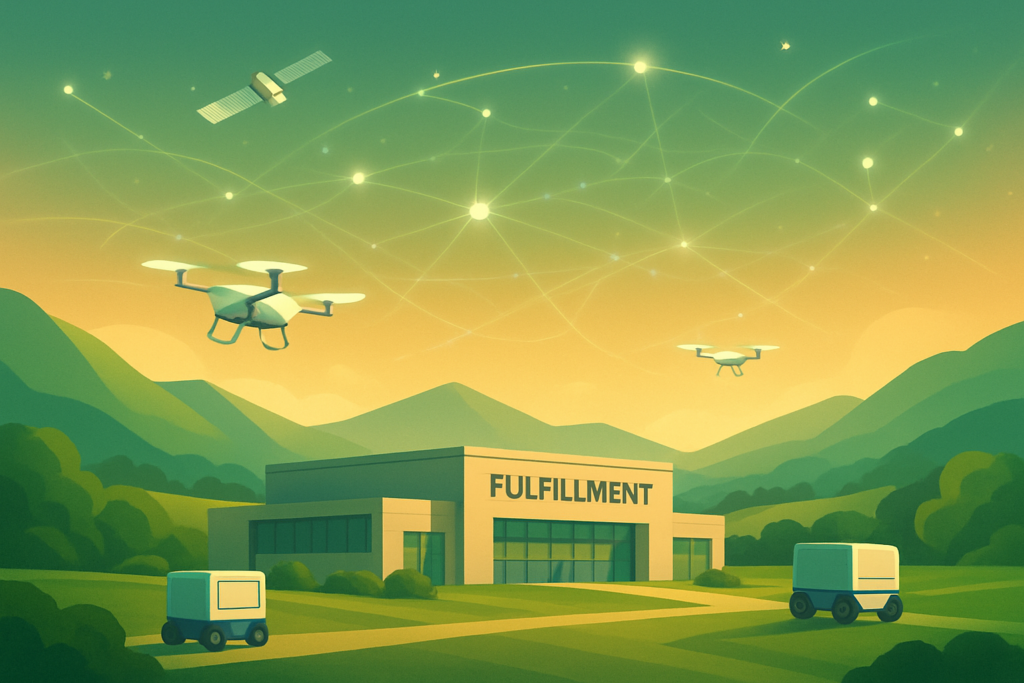
- Robotics: In fulfillment centers, the "Proteus" autonomous mobile robots (AMRs) now handle the majority of heavy lifting, significantly reducing injury rates and increasing throughput.
Competitive Landscape
Amazon faces a multi-front war with some of the most powerful entities on Earth:
- Cloud & AI: Microsoft (MSFT) and Google (GOOGL) are Amazon’s fiercest rivals. Microsoft’s partnership with OpenAI gave it an early lead in generative AI, but Amazon is fighting back with its "Silicon-to-Software" integration.
- Retail: Walmart (WMT) has successfully modernized its e-commerce and advertising arms, posing a serious threat to Amazon’s grocery and everyday-low-price dominance. Additionally, ultra-fast fashion players like Temu and Shein continue to pressure Amazon’s apparel and low-cost goods categories.
- Satellite Internet: SpaceX's Starlink is the incumbent, but Amazon’s existing relationship with millions of AWS and Prime customers provides a formidable distribution channel for Project Kuiper.
Industry and Market Trends
The "Age of Optimization" is currently defining the tech sector. Enterprises are no longer just moving to the cloud; they are optimizing their cloud spend to fund AI initiatives. This has created a "barbell" effect where basic compute is commoditized, but high-end AI training and inference demand a premium.
Furthermore, the regionalization of global supply chains—partially due to geopolitical tensions—has favored Amazon’s decision to build a more localized, regional logistics network in the US and Europe, reducing delivery times and "miles traveled" per package.
Risks and Challenges
- Capex ROI: The $200 billion capex plan for 2026 is a massive bet. If AI adoption slows or the Project Kuiper launch schedule slips, the "drag" on free cash flow could lead to significant stock underperformance.
- Regulatory Scrutiny: The FTC’s ongoing antitrust litigation remains a "dark cloud." While Amazon has defended its practices, potential forced divestitures or changes to the "Buy Box" algorithm could impact profitability.
- Labor Relations: Unionization efforts at US fulfillment centers continue to be a persistent operational and reputational risk.
- Execution Risk: Project Kuiper faces a strict FCC deadline to have half of its constellation (roughly 1,600 satellites) in orbit by July 2026 to keep its license.
Opportunities and Catalysts
- Advertising Expansion: Amazon’s DSP (Demand Side Platform) is now expanding into external streaming platforms like Netflix and Spotify, allowing Amazon to monetize its data outside its own ecosystem.
- Healthcare: Through One Medical and Amazon Pharmacy, the company is slowly but surely disrupting the primary care and prescription delivery market.
- AWS Backlog: With a contract backlog of $244 billion, AWS has years of guaranteed revenue growth already "baked in," providing a safety net for investors.
Investor Sentiment and Analyst Coverage
Wall Street remains broadly "Bullish" on Amazon, with approximately 90% of analysts maintaining a Buy or Strong Buy rating. The consensus view is that Amazon’s transition to a high-margin services company (AWS + Ads) is still in the middle innings. However, institutional investors are closely monitoring the "Capex-to-FCF" ratio, looking for signs that the massive infrastructure investments are yielding immediate margin improvements. Retail sentiment remains positive, largely driven by the utility of the Prime ecosystem.
Regulatory, Policy, and Geopolitical Factors
Amazon is increasingly entangled in global policy debates:
- EU Digital Markets Act (DMA): Amazon has had to adjust its data-sharing and self-preferencing practices in Europe to comply with new regulations.
- Geopolitical Data Residency: As governments demand that data be stored within their borders, AWS is forced to build "Sovereign Clouds," increasing complexity but also creating a moat against smaller competitors.
- Orbital Management: As a major player in LEO satellites, Amazon is under pressure to lead in space debris mitigation and orbital sustainability.
Conclusion
Amazon in March 2026 is no longer a retail company; it is an infrastructure colossus. It provides the servers that run the world’s AI, the logistics network that moves its goods, and soon, the satellites that connect its people.
For investors, the central question is whether the current $200 billion investment cycle will lead to a new era of dominance or if the company is overextending itself in the face of maturing markets. With a record $716 billion in revenue and an AWS backlog that continues to swell, the fundamentals remain robust. However, the next 18 months will be defined by execution—specifically in AI silicon and satellite deployment. For those with a 10-year horizon, Amazon’s "Everything Platform" remains one of the most compelling stories in the global equity market.
This content is intended for informational purposes only and is not financial advice.