

As of February 23, 2026, the global technology landscape is defined by a singular, gravity-defying force: NVIDIA Corporation (NASDAQ: NVDA). Once a niche provider of graphics cards for gamers, NVIDIA has evolved into the central nervous system of the modern digital economy. Today, the company stands at a critical crossroads as it officially signals its re-entry into the consumer PC processor market, challenging the long-standing x86 duopoly of Intel and AMD. With a market capitalization that has reshaped indices and an influence that spans from sovereign data centers in Riyadh to the laptops of creative professionals in Tokyo, NVIDIA is no longer just a "chip company"—it is the architect of the AI era.
Historical Background
Founded in 1993 by Jensen Huang, Chris Malachowsky, and Curtis Priem, NVIDIA’s journey began with the vision of bringing 3D graphics to the gaming and multimedia markets. The launch of the RIVA TNT in 1998 and the GeForce 256 in 1999—marketed as the world’s first "GPU"—set the stage for decades of dominance in gaming.
However, the pivotal moment in NVIDIA’s history was the 2006 introduction of CUDA (Compute Unified Device Architecture). By allowing researchers to use GPUs for general-purpose parallel processing, NVIDIA laid the groundwork for the deep learning revolution. While the 2010s saw steady growth through gaming and professional visualization, the 2020s catalyzed a transformation. The acquisition of Mellanox in 2020 integrated high-performance networking into their stack, and the generative AI explosion of 2023-2025 turned NVIDIA into an indispensable utility for the world’s largest hyperscalers.
Business Model
NVIDIA’s business model has shifted from selling discrete components to providing full-stack "AI Factories." Its revenue is currently categorized into four primary segments:
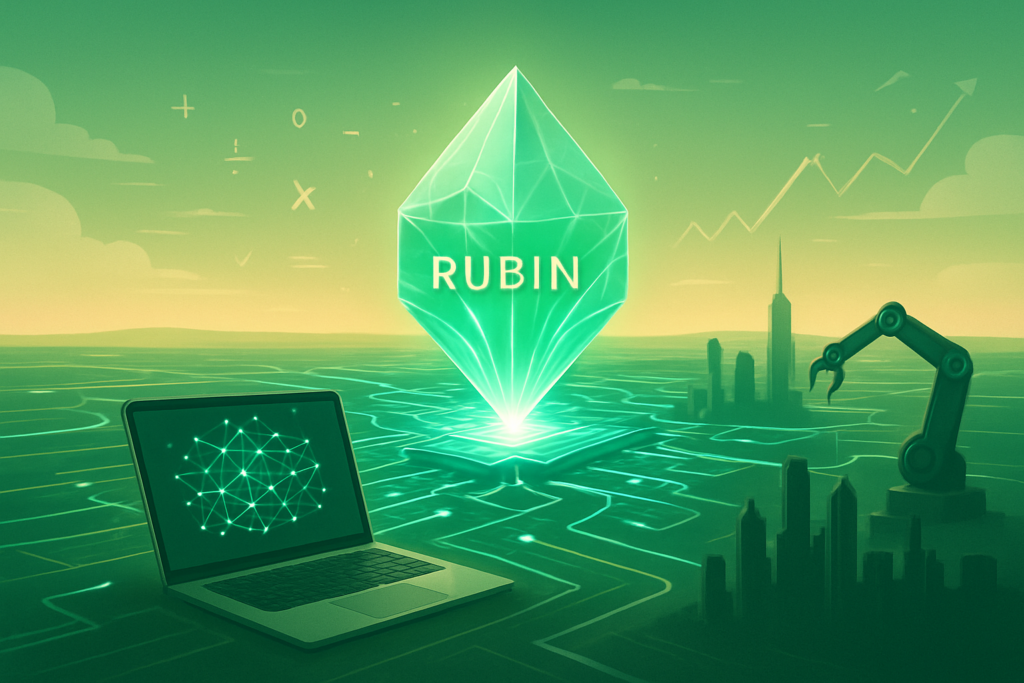
- Data Center: The undisputed crown jewel, accounting for over 85% of total revenue. This includes the H100, H200, Blackwell (B200), and the newly unveiled Rubin (R100) platforms, alongside InfiniBand and Spectrum-X networking gear.
- Gaming and AI PCs: Formerly the flagship segment, it now serves as a secondary but vital pillar. This segment is currently being revitalized by the launch of NVIDIA’s proprietary Arm-based "N1" and "N1X" CPUs for the Windows on Arm ecosystem.
- Professional Visualization: Focused on the "Omniverse" and digital twins, serving industries like automotive design and architecture.
- Automotive and Robotics: A high-growth sector providing the "Thor" centralized computer for autonomous driving and the "Isaac" platform for humanoid robotics.
Stock Performance Overview
Over the past decade, NVDA has been one of the greatest wealth-creation engines in market history.
- 10-Year Performance: Adjusted for multiple stock splits (including the landmark 10-for-1 split in 2024 and a subsequent 5-for-1 in late 2025), the stock has returned over 25,000%.
- 5-Year Performance: Driven by the AI gold rush, the stock has risen roughly 1,200%, vastly outperforming the S&P 500 and the Nasdaq-100.
- 1-Year Performance: Despite concerns of a "AI bubble," the stock is up 78% over the last 12 months, propelled by the seamless transition from the Hopper architecture to Blackwell and the recent excitement surrounding the "Vera Rubin" platform.
Financial Performance
In its most recent fiscal Q3 2026 report (ending October 2025), NVIDIA reported a staggering $57.0 billion in revenue, a 62% increase year-over-year.
- Margins: Gross margins remain the envy of the industry at ~75.2%, reflecting the company’s massive pricing power and the software-rich nature of its "AI enterprise" offerings.
- Cash Flow: The company generated over $22 billion in free cash flow in the last quarter alone, fueling a $50 billion share buyback program and aggressive R&D spending.
- Valuation: As of February 23, 2026, NVDA trades at a forward P/E ratio of 34x—historically high, but arguably justified by its projected 45% EPS growth rate for the upcoming fiscal year.
Leadership and Management
CEO Jensen Huang remains the most influential figure in semiconductor history. His "leather jacket" persona belies a rigorous, flat organizational structure that prioritizes speed and innovation. The leadership team, including CFO Colette Kress, has been lauded for its masterful management of supply chains during the 2024-2025 "chip wars."
The board’s strategy has recently shifted toward "Sovereign AI," helping nation-states build their own AI infrastructure. Governance ratings remain high, though the company’s sheer size has invited increased scrutiny from antitrust regulators in the EU and the US.
Products, Services, and Innovations
The current product portfolio is headlined by the Blackwell architecture, which became the standard for LLM training in 2025. However, the market’s current focus is on two new frontiers:
- The Rubin Platform: Utilizing HBM4 memory and the "Vera" Arm-based CPU, Rubin aims to provide a 2.5x performance-per-watt leap over Blackwell.
- The N1X Consumer CPU: On this day, February 23, 2026, reports have confirmed that NVIDIA's first dedicated Windows-on-Arm processor is appearing in premium "AI PC" laptops from Dell and ASUS. These chips integrate NVIDIA’s RTX graphics with a high-efficiency Arm CPU, directly challenging Apple’s M4 and M5 chips in the creative market.
Competitive Landscape
NVIDIA maintains a dominant 88% share of the AI accelerator market, but the walls are being tested:
- Advanced Micro Devices (NASDAQ: AMD): The Instinct MI350 and MI400 series have gained traction as "second-source" options for Meta and Microsoft, holding roughly 9% of the market.
- Intel (NASDAQ: INTC): While struggling in the data center, Intel remains a fierce rival in the PC market. Ironically, NVIDIA and Intel announced a "coopetition" deal in late 2025 to package NVIDIA GPUs with Intel x86 CPUs in certain enterprise segments.
- Custom Silicon: Hyperscalers like Amazon (AWS Trainium) and Google (TPU v6) continue to build internal chips, though they remain largely complementary to NVIDIA’s more versatile ecosystem.
Industry and Market Trends
Two major trends are defining 2026:
- The AI PC Cycle: The industry is moving away from cloud-only AI toward "Edge AI." NVIDIA’s entry into the PC CPU market is a direct play for this $100 billion opportunity.
- Power Constraints: As data centers face electricity shortages, NVIDIA’s focus has shifted from raw performance to "efficiency-first" architectures, leveraging liquid cooling and low-voltage signaling.
Risks and Challenges
Despite its dominance, NVIDIA faces non-trivial risks:
- Supply Chain Concentration: A heavy reliance on TSMC (Taiwan Semiconductor Manufacturing Co.) for 3nm and 2nm production remains a geopolitical single point of failure.
- GDDR7 Shortages: A global shortage of next-generation GDDR7 memory has delayed the launch of the consumer RTX 60-series gaming GPUs until late 2026.
- Customer Concentration: Five major "Hyperscalers" account for nearly 50% of NVIDIA’s data center revenue. Any pivot by these giants toward internal silicon could significantly impact the bottom line.
Opportunities and Catalysts
- The "Meta Supercycle": A recent mid-February 2026 announcement confirmed that Meta will deploy millions of standalone Grace CPUs, representing a major diversification of NVIDIA's revenue beyond just GPUs.
- China Market Resumption: Following the "Dec-25 Policy Shift," NVIDIA has begun shipping specialized H200-class chips to the Chinese market, a segment that could add $10 billion in incremental revenue in 2026.
- GTC 2026: The upcoming "GPU Technology Conference" in March is expected to showcase the "Feynman" architecture, designed for the first trillion-parameter models.
Investor Sentiment and Analyst Coverage
Wall Street remains overwhelmingly bullish. Of the 65 analysts covering NVDA as of Feb 23, 2026, 58 maintain a "Strong Buy" or "Buy" rating. Institutional ownership has reached record levels, with major hedge funds increasing positions in anticipation of the PC market re-entry. Retail sentiment, measured by social media engagement, remains high, though there is growing "valuation fatigue" among conservative value investors.
Regulatory, Policy, and Geopolitical Factors
Geopolitics remains NVIDIA’s most volatile variable. The company is currently navigating a complex web of U.S. export controls. While the late 2025 easing of certain restrictions allowed for renewed shipments to China, ongoing tensions over Taiwan keep the "geopolitical risk premium" high. Additionally, the FTC is reportedly investigating NVIDIA’s software bundling practices (CUDA), a development that investors are watching closely.
Conclusion
NVIDIA enters the spring of 2026 not as a graphics company, but as a total computing powerhouse. Its re-entry into the PC CPU market marks the final piece of the puzzle, allowing the company to control the "three-headed monster" of modern computing: the GPU, the CPU, and the Network. While risks regarding supply chains and customer concentration persist, NVIDIA’s relentless release cadence—moving from a biennial to an annual product cycle—makes it difficult for competitors to close the gap. For investors, the "Vera Rubin" era represents not just a hardware upgrade, but the cementation of NVIDIA as the essential infrastructure of the 21st century.
This content is intended for informational purposes only and is not financial advice.