
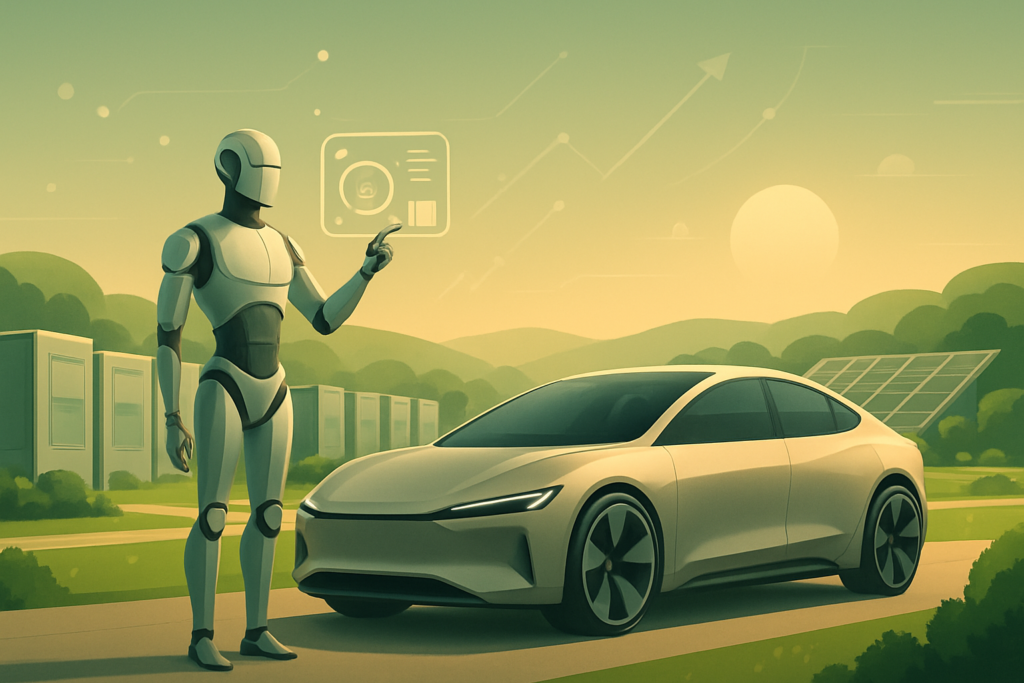
As of January 27, 2026, Tesla Inc. (NASDAQ: TSLA) finds itself at a defining inflection point. Once the undisputed champion of the global electric vehicle (EV) revolution, the company is currently navigating a "Great Reset." After a fiscal year 2025 characterized by the first consecutive decline in annual delivery volumes and a dramatic shift in the U.S. regulatory landscape, Tesla is no longer just an automaker in the eyes of its leadership or its most ardent investors. It is an AI and robotics firm attempting to execute the most ambitious pivot in corporate history.
With the repeal of the $7,500 federal EV consumer tax credit late last year and quarterly earnings scheduled for release tomorrow, the stakes have rarely been higher. Investors are grappling with a paradox: Tesla’s core automotive margins are under immense pressure, yet its "moonshot" projects—the Cybercab and Optimus—are closer to reality than ever before. This article explores the internal and external forces shaping Tesla as it prepares to report its Q4 2025 results.
Historical Background
Founded in 2003, Tesla’s journey began not with a mass-market car, but with a mission to prove that electric vehicles could be superior to gasoline counterparts. The 2008 Roadster set the stage, but it was the Model S in 2012 that redefined the luxury sedan. The company’s "production hell" during the Model 3 ramp-up in 2017-2018 became the stuff of Silicon Valley legend, nearly pushing the firm to bankruptcy before it achieved the scale necessary for sustained profitability.
By 2020, Tesla had become the most valuable automaker in the world, joined the S&P 500, and sparked a global arms race in electrification. However, the period between 2023 and 2025 saw the "halo" begin to dim. High interest rates, increased competition from Chinese manufacturers like BYD (SZSE: 002594), and a maturing EV market forced Tesla into a series of aggressive price cuts. Today, the narrative has shifted from "how many cars can they build?" to "can they win the race for autonomous intelligence?"
Business Model
Tesla’s business model is a multi-pronged ecosystem designed to capture value across the energy and transportation lifecycle:
- Automotive: The primary revenue driver, consisting of the Model 3, Model Y, Model S, Model X, and the Cybertruck. The upcoming "Model 2" (Next-Gen Platform) is expected to target the sub-$30,000 market.
- Energy Generation and Storage: This segment has become the "quiet giant" of Tesla’s balance sheet. Through the Megapack (utility-scale) and Powerwall (residential), Tesla is scaling its energy division at margins significantly higher than its current automotive business.
- Services and Other: This includes Supercharging revenue, insurance, and vehicle repairs. As the global fleet of Teslas grows, this recurring revenue stream becomes increasingly vital.
- AI and Software: Full Self-Driving (FSD) is sold as both a one-time purchase and a $99/monthly subscription. This segment represents the highest potential margin, as it is essentially a high-margin software play.
Stock Performance Overview
Tesla’s stock performance has been a rollercoaster for long-term holders.
- 10-Year Horizon: TSLA remains one of the best-performing stocks in history, having grown by over 1,200% as it scaled from a niche player to a global titan.
- 5-Year Horizon: The performance reflects the 2021 peak followed by significant volatility. The stock has weathered multiple 40-50% drawdowns, often moving in lockstep with Elon Musk’s public profile and interest rate shifts.
- 1-Year Horizon (2025-2026): The past 12 months have been difficult. Tesla trailed the broader S&P 500 in 2025 as delivery growth turned negative and investors reacted to the loss of U.S. federal subsidies. However, the stock has seen a recent "AI bounce" in early 2026, fueled by optimism surrounding the Cybercab rollout.
Financial Performance
The upcoming Q4 2025 earnings report is expected to reflect the "demand vacuum" created by the expiration of the $7,500 federal tax credit on September 30, 2025.
- Revenue & Earnings: Analysts are bracing for Q4 revenue of approximately $24.7 billion, a year-over-year decline. Consensus EPS is pegged at $0.45, down from the $0.70+ levels seen in 2024.
- Margins: This is the most scrutinized metric. Automotive gross margins (excluding credits) have plummeted from peaks of 25%+ to roughly 14.3% in late 2025. This compression is the result of price cuts and the lack of subsidies to prop up consumer demand.
- Cash Flow: Despite the margin pressure, Tesla remains "fortress-like" with a cash pile exceeding $30 billion, allowing it to self-fund the massive R&D required for the Optimus and Dojo programs.
Leadership and Management
Elon Musk remains the singular force behind Tesla, though his attention is increasingly split between X (formerly Twitter), SpaceX, and his involvement in governmental efficiency initiatives under the current U.S. administration.
While Musk provides the vision, the operational heavy lifting has shifted to executives like Tom Zhu (Senior VP of Automotive) and Vaibhav Taneja (CFO). The board of directors has faced criticism for being overly deferential to Musk, particularly regarding his 2024 pay package, but they argue that his "Key Man" status is what sustains Tesla’s premium valuation compared to legacy automakers like Ford (NYSE: F) or GM (NYSE: GM).
Products, Services, and Innovations
Tesla’s current lineup is aging, but its innovation pipeline is focused on the next decade:
- The Cybercab: This dedicated Robotaxi, devoid of a steering wheel or pedals, is scheduled for volume production in Q2 2026. It represents Tesla’s transition to a service-based "transportation as a utility" model.
- Optimus (Gen 3): The humanoid robot has seen rapid iterations. By January 2026, Optimus Gen 3 features improved tactile sensors and is being deployed in limited numbers within Tesla’s own Fremont and Texas factories to handle simple logistical tasks.
- FSD V14: The latest iteration of Full Self-Driving has moved toward a "vision-only" end-to-end neural network, aiming to achieve "unsupervised" status in several U.S. states by the end of this year.
Competitive Landscape
The competition has never been more fierce:
- BYD (SZSE: 002594): The Chinese giant officially surpassed Tesla in total battery-electric vehicle (BEV) production in 2025, leveraging a massive vertical integration advantage and a lower cost structure.
- Rivian (NASDAQ: RIVN) & Lucid (NASDAQ: LCID): While still struggling with profitability, these players compete for the premium U.S. buyer.
- Autonomous Rivals: Alphabet’s (NASDAQ: GOOGL) Waymo currently leads in actual autonomous miles driven in urban environments, though Tesla argues its "fleet-scale" data approach will eventually win out.
Industry and Market Trends
The "EV Winter" of 2025 saw a cooling of consumer enthusiasm for pure electrics in favor of hybrids. High insurance costs and "range anxiety" persist in the mass market. However, the broader trend is the shift toward "Software-Defined Vehicles" (SDVs). The industry is moving away from selling a hardware product once and toward a model of constant software updates and feature-as-a-service subscriptions—a field where Tesla maintains a significant lead over legacy OEMs.
Risks and Challenges
Tesla faces several existential and operational risks:
- The Subsidy Cliff: The removal of the $7,500 federal credit has made Tesla vehicles 10-15% more expensive for the average U.S. consumer overnight.
- Regulatory Scrutiny: NHTSA continues to investigate FSD-related incidents. Any major setback in "unsupervised" certification would delay the Robotaxi narrative indefinitely.
- Execution Risk: Musk’s timelines for Optimus and Cybercab are notoriously optimistic. A delay into 2027 or 2028 could lead to a severe de-rating of the stock.
- Commodity Volatility: While lithium prices have stabilized, geopolitical tensions in the supply chain for rare earth minerals remain a constant threat.
Opportunities and Catalysts
- Energy Storage Scaling: The Lathrop and Shanghai Megafactories are operating at full tilt. The energy business could contribute up to 25% of Tesla’s total profit by 2027.
- The "Model 2" Reveal: Rumored for a late 2026 launch, a truly affordable Tesla could re-ignite the delivery growth story.
- Licensing FSD: If Tesla successfully licenses its autonomous stack to another major automaker (rumors persist regarding Ford or Volkswagen), it would provide a pure-margin revenue stream with no hardware overhead.
Investor Sentiment and Analyst Coverage
Wall Street is deeply polarized on TSLA.
- Bulls (e.g., Wedbush, Ark Invest): See Tesla as the world’s largest AI project. They focus on the "sum of the parts" valuation, where the car business is merely a Trojan horse for FSD and Optimus.
- Bears (e.g., JP Morgan, Bernstein): View Tesla as a cyclical car company with a tech-stock valuation. They point to the declining market share and the margin-dilutive effect of losing government incentives.
- Retail Sentiment: Tesla remains a "cult stock" with massive retail following, which often provides a floor for the price during institutional sell-offs.
Regulatory, Policy, and Geopolitical Factors
The current U.S. administration’s shift away from green energy subsidies has been a headwind for the industry at large. However, Elon Musk’s unique relationship with the executive branch may provide a "regulatory moat" for Tesla, potentially fast-tracking autonomous driving permits that competitors might struggle to obtain. Internationally, the threat of European and American tariffs on Chinese EVs acts as a double-edged sword, protecting Tesla’s domestic market while complicating its global supply chain.
Conclusion
Tesla enters the 2026 fiscal year in the midst of a high-stakes transformation. The "low-hanging fruit" of the EV era—fueled by early adopters and government subsidies—has been picked. To justify its current valuation, Tesla must now prove that its AI and robotics prowess can translate into bottom-line results that offset the cooling of the global auto market.
Investors should watch the Q4 automotive gross margin closely; a dip below 14% could trigger further short-term pain. However, the ultimate "North Star" for the company remains the April 2026 Cybercab launch. If Tesla can successfully transition from selling cars to selling autonomous miles, the current "reset" will be remembered as the foundation for its next multi-trillion-dollar leg of growth.
This content is intended for informational purposes only and is not financial advice.